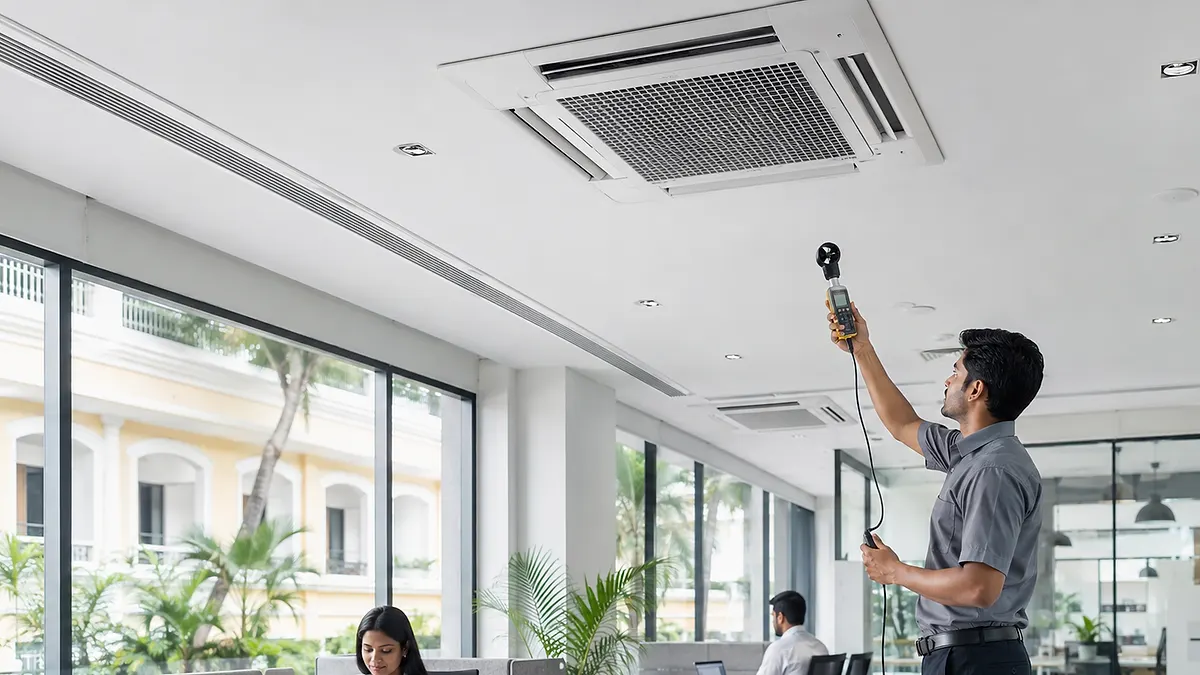
How often should a commercial VRF system be maintained?
VRF maintenance should use a condition- and risk-based schedule rather than one annual visit. High-use commercial systems need frequent operator checks, scheduled filter and drain care, periodic professional inspection, alarm review and seasonal performance verification, with intervals adjusted for operating hours, occupancy, coastal exposure and equipment documentation.
Frequency should reflect duty, environment and business impact
A VRF system connects many indoor units, controls and refrigerant branches to one or more outdoor modules. Maintenance planning must cover the complete system because a local complaint can be caused by an indoor component, shared outdoor condition, communication fault or control setting.
Use manufacturer requirements as the baseline, then increase inspection where filters load quickly, drains serve high-humidity zones, equipment runs extended hours, critical spaces cannot tolerate downtime or coastal exposure is severe. Maintenance records should show findings and trends, not only attendance dates.
Pondicherry's coastal humidity and salt exposure can increase corrosion and drainage risk, while hotels, hospitals, offices, showrooms and server areas have very different operating loads. Each asset group needs its own maintenance frequency.
Three inputs that determine VRF maintenance frequency
A useful schedule changes when system risk changes.
Operating duty
Record daily hours, seasonal load, occupied zones, after-hours cooling and critical areas such as server or treatment rooms.
Environment and access
Assess dust, grease, humidity, salt exposure, roof heat, ceiling access, drain routing and outdoor ventilation.
Performance history
Use alarms, repeat complaints, filter loading, drain events, corrosion, component failures and energy trends to adjust the interval.
What a VRF preventive-maintenance plan should include
Indoor units and filters
Track every indoor unit, filter, coil, fan, drain, controller and access restriction by asset ID.
Outdoor modules
Inspect coil condition, fans, clearances, mounting, terminals, pipe support and coastal corrosion indicators.
Controls and alarms
Review error history, communication status, schedules, set points, central controls and unresolved intermittent faults.
Performance and records
Record temperatures, operating observations, corrective actions, pending parts and verification after maintenance.
A practical VRF maintenance-frequency matrix
The table is a planning framework, not a substitute for the manufacturer schedule or site risk assessment. Critical buildings may require more frequent inspection, remote monitoring and standby arrangements.
Create separate frequencies for indoor filters, drains, outdoor coils, controls and professional testing instead of placing every task into one quarterly checklist.
| Activity | Planning frequency | Adjust when |
|---|---|---|
| Operator visual and alarm review | Daily or weekly | Critical operation or recurring alarms |
| Filter and drain condition check | Monthly or condition-based | High dust, occupancy or humidity |
| Professional preventive inspection | Quarterly or seasonal | Long hours or severe exposure |
| System performance review | Before peak season and after major work | Comfort, energy or repeat-fault trends change |
Use the exact equipment manufacturer's maintenance requirements and competent personnel for refrigerant, electrical and control-system work.
A completed checklist should produce evidence
A signature alone does not show whether filters were loaded, drains were flowing, corrosion was progressing or alarms were cleared. Record asset IDs, photographs where useful, readings, defects, recommended actions and final status.
Trend repeat complaints by zone. If one area repeatedly overheats or leaks, investigate load, airflow, controls, installation and drainage rather than performing the same cleaning at every visit.
- Maintain an indoor- and outdoor-unit asset register.
- Separate completed work from observations and pending repairs.
- Track alarms and complaint recurrence.
- Review the schedule after any major breakdown or occupancy change.
How to create a maintainable VRF schedule
- 1
Build the asset register
List outdoor modules, every indoor unit, controller, branch component and served zone.
- 2
Assess risk
Score operating duty, environment, business impact, access and failure history.
- 3
Assign task frequencies
Set separate intervals for operator checks, filters, drains, coils, controls and professional testing.
- 4
Record findings
Use consistent asset IDs, readings, photographs, alarms and action owners.
- 5
Review performance
Adjust the plan from complaints, breakdowns, energy behaviour and seasonal conditions.
Documents to request from a VRF service provider
Request a complete asset schedule, task matrix, visit calendar, response-time agreement, exclusions, refrigerant and spare-parts terms, safety plan and sample service report before awarding an AMC.
For buildings across Pondicherry, Villupuram, Cuddalore and Chidambaram, confirm travel coverage, escalation contacts and how emergency faults will be prioritised.
Ask what is included, what is excluded, which findings support additional work and how the final result will be tested.
Common mistakes to avoid
- Giving every component the same maintenance interval.
- Ignoring alarm history after resetting the controller.
- Recording visits without asset-level findings or measurements.
- Approving work without asking how the final result will be tested and recorded.
Frequently asked questions
How often should VRF AC systems be serviced in Pondicherry?
Use frequent operator checks, monthly or condition-based filter and drain inspections, quarterly or seasonal professional maintenance and performance review before peak use. Adjust these planning intervals to the manufacturer and site risk.
Why is one annual VRF service usually insufficient?
Commercial systems have many indoor units, drains, controls and operating zones. Filters, alarms or drainage problems can develop well before an annual visit, especially under heavy use.
Should every VRF indoor unit have an asset number?
Yes. Asset identification connects complaints, cleaning, alarms, parts and readings to the correct indoor unit and served zone.
Does VRF maintenance include refrigerant charging?
Not automatically. Refrigerant work should follow fault diagnosis and leak assessment. The AMC must clearly state what testing, repair, refrigerant and documentation are included.
What should a VRF maintenance report contain?
It should record assets inspected, tasks completed, filter and drain condition, alarms, readings, defects, corrective action, pending work and post-maintenance verification.
Talk to Turbo Cooling Solutions
Share your location, AC type and requirement for a clear service response.