What should you expect?
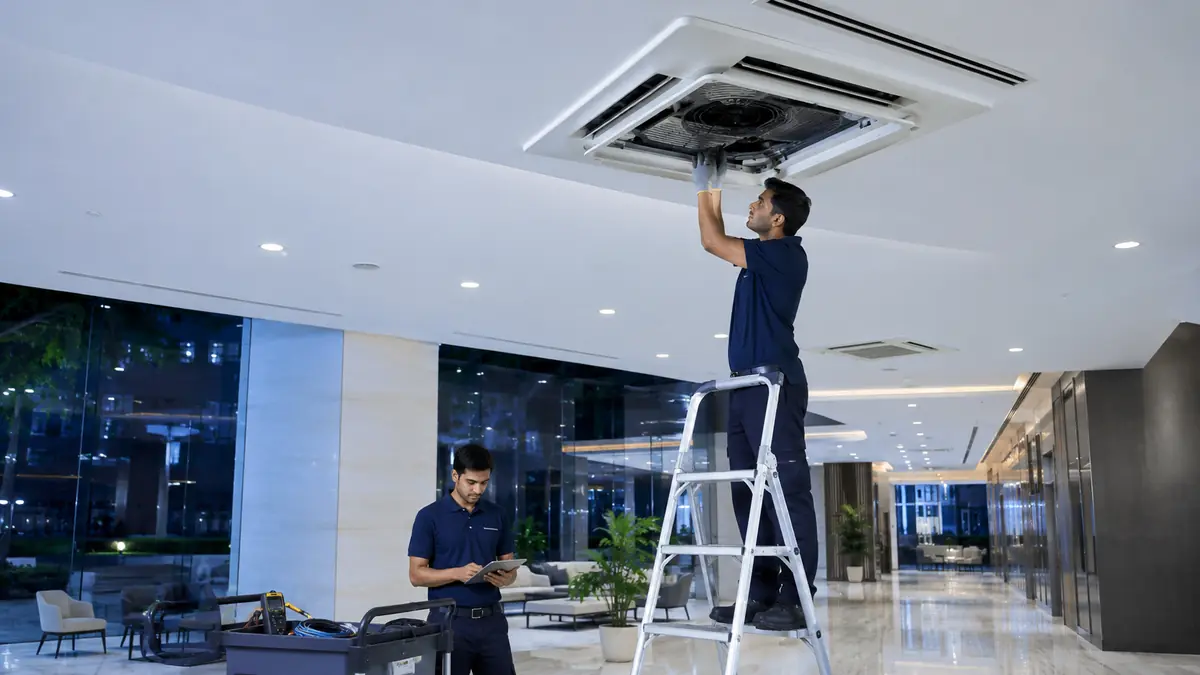
Commercial AC service in Pondicherry should protect comfort and operations through asset-wise planning, safe access, minimal disruption, measured checks, drainage and airflow verification, control review and clear service reporting.
How should commercial AC service be planned?
Commercial sites have different priorities from homes: multiple assets, long operating hours, occupied work areas, critical zones, customer comfort and limited shutdown windows. Pondicherry’s heat, humidity and coastal exposure add local maintenance considerations.
Begin with an equipment and zone list. Identify critical rooms, business hours, safe access, complaint history and high-load periods. Service should then be coordinated asset by asset, with findings and final results recorded so decisions are based on evidence rather than memory.
Pondicherry’s coastal humidity, salt-laden air, monsoon moisture and long cooling seasons can increase filter loading, condenser fouling, corrosion risk, insulation wear and drain problems. Service decisions should follow the AC type, actual condition, daily use and manufacturer guidance.
Commercial priorities before service begins
Planning reduces downtime and protects staff, customers, equipment and interiors.
Asset and zone criticality
Prioritise server rooms, customer areas, kitchens, clinics or production zones according to operational risk.
Business-safe timing
Coordinate isolation, ladders, ceiling access, water protection and noise around occupancy and business hours.
System-wide airflow
Check return air, filters, coils, blowers, grilles, dampers and outdoor heat rejection—not only the complaint unit.
Reporting and follow-up
Record work, measurements, repeat faults, priority actions, parts and the next review for each asset.
Commercial AC service scope
Pre-service survey
List assets, zones, controls, operating hours, complaints, access restrictions and critical business areas.
Coordinated technical checks
Inspect airflow, filters, heat exchangers, fans, drainage, controls, electrical condition and outdoor ventilation.
Safe occupied-site execution
Use barriers, floor and ceiling protection, controlled cleaning and approved isolation around people and property.
Asset-wise handover report
Document findings, work, parts, readings, unresolved risks and recommended priorities.
From enquiry to tested handover
- 1
Share the asset list and operating needs
Provide AC types, quantities, locations, business hours, critical zones and current complaints.
- 2
Survey access and condition
Review safe access, ceiling or plant areas, protection requirements and representative equipment condition.
- 3
Approve a phased scope
Define assets, tasks, timing, reporting, breakdown support, exclusions and approval limits.
- 4
Execute with minimal disruption
Coordinate shutdowns, protect occupied areas and update the site contact when additional work is found.
- 5
Verify zones and report
Confirm representative comfort, airflow, drainage and control response, then issue an asset-wise summary.
What should a commercial service report contain?
The report should identify the asset, location, complaint, condition, work completed, parts or materials, relevant observations, unresolved items and priority. Photos and readings can help where they explain a fault or trend.
Over time, reports should reveal repeat failures, high-maintenance assets, comfort hotspots and areas needing capital planning. This makes service data useful for operations and budgeting.
Ask what is included, what is excluded, which findings support additional work and how the final result will be tested.
Common mistakes to avoid
- Servicing every asset identically without considering operating hours and criticality.
- Working in occupied areas without barriers, protection and a coordinated shutdown plan.
- Accepting a generic completion note with no asset-wise findings or unresolved priorities.
- Approving work without asking which final measurements, drainage checks and operating tests will confirm the result.
Local AC support across Pondicherry
Service availability depends on the exact address, AC type, access, required scope and current schedule. The locality examples below help users describe the site clearly; they do not replace booking confirmation.
Central Pondicherry
Enquiries from White Town, Heritage Town, Orleanpet, Nellithope and nearby central areas can be checked against technician availability and site access.
North and west neighborhoods
Lawspet, Muthialpet, Kalapet, Oulgaret and surrounding locations may have different building access, outdoor-unit exposure and operating conditions.
South and suburban areas
Mudaliarpet, Reddiarpalayam, Ariyankuppam and nearby areas can be reviewed when the address, AC type and requested service are shared.
Frequently asked questions
What types of commercial AC can be serviced?
The exact capability and scope depend on the site and equipment, but commercial systems may include split, cassette, ductable, packaged and multi-zone units. Share the asset list before confirmation.
Can commercial AC service be scheduled outside business hours?
Timing depends on technician availability, site rules, access and the work involved. Share operating hours and shutdown restrictions so a practical window can be discussed.
What should a commercial AC quotation include?
It should list covered assets, inspection and cleaning tasks, visit timing, reporting, minor materials, parts approval, refrigerant, exclusions, taxes and breakdown support where applicable.
How can businesses reduce repeat AC complaints?
Keep asset-wise records, review operating schedules, maintain clear airflow paths, address drainage and insulation, investigate repeat faults and prioritise critical zones using service findings.
Does Turbo Cooling Solutions serve Pondicherry businesses?
Commercial enquiries can be reviewed for Pondicherry offices, shops and other facilities. Share the address, asset count, AC types, operating hours and required scope.
Talk to Turbo Cooling Solutions
Share your Pondicherry address, AC type, model, symptom and preferred timing so the requirement can be reviewed before work is confirmed.