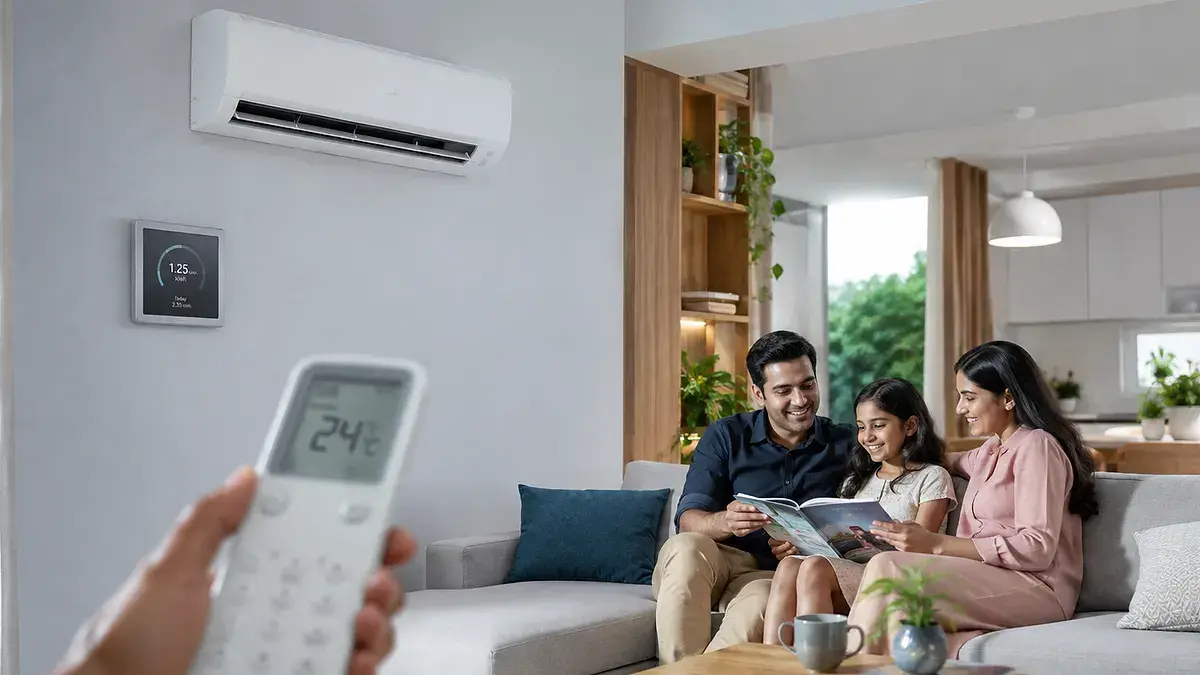
How does room sealing reduce AC electricity use?
Seal uncontrolled gaps around doors, windows, wall sleeves, pipe penetrations and false ceilings while preserving required ventilation and safe combustion air. Warm humid leakage increases both heat and moisture load, extending AC run time. Start with visible light, drafts, dust trails and damaged seals; use suitable removable or permanent materials and never block a designed fresh-air, exhaust or safety opening.
Seal accidental leakage, not intentional ventilation
A cooling system must remove every unit of heat and moisture that enters. Reducing uncontrolled leakage can improve comfort and lower demand without changing the AC.
Inspect during daylight and windy conditions, especially at frequently used doors, sliding windows, AC pipe sleeves and ceiling edges. For businesses, coordinate sealing with indoor-air-quality and ventilation needs. Kitchens, bathrooms and rooms with fuel-burning appliances require special care.
Across Pondicherry, Villupuram, Cuddalore and Chidambaram, heat, humidity, dust, coastal exposure and room construction vary. Apply the guidance to the actual site instead of using one setting or schedule for every property.
What to check before approving work
Start with safe, observable conditions and move to model-specific technical tests only when the evidence requires them.
Doors and windows
Look for light, worn weather seals, warped frames and gaps at thresholds or sliding tracks.
Service penetrations
Check pipe, cable, drain and exhaust openings for safe, weather-resistant closure.
Ceiling and adjoining spaces
Inspect false-ceiling returns, attic hatches and open passages into unconditioned areas.
Professional checks for AC Room Sealing
Leakage map
Record gap location, approximate size, moisture signs and whether it is designed ventilation.
Material selection
Choose seals that suit movement, weather, fire safety and future service access.
Ventilation review
Preserve required outdoor air, exhaust and pressure balance for the room use.
After-sealing check
Monitor humidity, odour, door pressure, condensate and AC run time.
Common leakage points and suitable responses
One symptom can have several causes. Use the pattern, timing and accompanying signs to narrow the next test instead of replacing parts from a guess.
The table is a decision aid, not a substitute for model-specific procedures, safe instruments or manufacturer service information.
| Leakage point | Typical evidence | Response |
|---|---|---|
| Door threshold | Light, dust line or warm draft | Adjust sweep or threshold seal |
| Sliding window | Loose meeting rails | Repair latch and weather strip |
| AC pipe sleeve | Open annular gap | Use serviceable weatherproof seal |
| False ceiling | Warm return air from void | Assess partitions and designed return path |
Do not seal a combustion-air opening, bathroom or kitchen exhaust, fire-safety vent or designed fresh-air path without professional building review.
How can you measure the effect of sealing?
The final test should reproduce the original operating condition as closely as practical and show whether the reported problem is resolved.
Record the work completed, relevant readings, parts used and any remaining limitation so a future visit starts with evidence rather than assumptions.
- Visible gaps and drafts are reduced.
- Required ventilation still operates.
- Humidity and comfort improve.
- Doors open and close safely.
- AC kWh or run-time trend improves under comparable use.
From first observation to verified handover
- 1
Find uncontrolled gaps
Use visual evidence, dust tracks and safe draft checks.
- 2
Classify each opening
Separate leakage from designed ventilation, exhaust and safety needs.
- 3
Prioritize large leaks
Address frequently open or clearly unsealed boundaries first.
- 4
Seal appropriately
Use durable materials that allow required movement and service.
- 5
Monitor comfort and air quality
Review humidity, odour and energy after changes.
Share useful details before the visit
Send the model, AC type, location, symptom timing, settings, error code and a short video where useful. Mention recent cleaning, shifting, electrical work, refrigerant work or power events.
Ask for an itemised scope that separates inspection, cleaning, labour, parts, refrigerant and follow-up tests. Keep the service report for warranty and repeat-fault history.
Ask what is included, what is excluded, which findings support additional work and how the final result will be tested.
Common mistakes to avoid
- Blocking designed ventilation to chase lower energy use.
- Using expanding material around hot or unsafe components.
- Ignoring frequently open doors while sealing tiny cracks.
- Approving work without asking how the final result will be tested and recorded.
Frequently asked questions
Should an AC room be completely airtight?
No. Reduce uncontrolled leakage while maintaining safe, code-compliant ventilation and exhaust for the room's use.
Where does most AC room leakage occur?
Common points include door thresholds, sliding windows, wall sleeves, pipe penetrations, false ceilings and open passages.
Can sealing reduce humidity?
It can reduce warm humid outdoor air entering, helping the AC manage moisture more effectively.
Is a door curtain enough?
A curtain may reduce direct exchange but does not replace a well-closing door and suitable seals.
How do I compare energy before and after sealing?
Track kWh, operating hours, weather, occupancy and settings over comparable periods.
Talk to Turbo Cooling Solutions
Share your location, AC type and requirement for a clear service response.