Why does the AC need so long to cool the room?
Slow cooling can come from a very hot or humid starting room, open doors, roof or west-wall heat, undersized capacity, low airflow, dirty coils, poor outdoor ventilation, voltage or control issues and refrigerant-circuit faults. Measure starting conditions and temperature trend, restore airflow and reduce avoidable room load first. If performance remains weak, request a complete diagnostic test rather than an automatic gas refill.
Compare similar conditions and measure the trend
Pull-down time changes with starting temperature, humidity, room volume, heat stored in walls and furniture, people, appliances and outdoor conditions. One universal cooling-time promise is unreliable.
In Chidambaram, a closed top-floor room can hold substantial heat and moisture. Note time of day, sun exposure, doors, people and fan speed. A healthy AC may need longer after the room has heat-soaked, but persistent weakness deserves airflow, capacity and equipment checks.
Chidambaram experiences hot, humid conditions with seasonal dust and rain. AC decisions should consider room use, closure periods, drainage, outdoor exposure and the condition found during inspection.
What to check before approving work
Start with safe, observable conditions and move to model-specific technical tests only when the evidence requires them.
Starting room load
Record room temperature, humidity, sun, occupancy, appliances and door opening.
Airflow condition
Check filter, intake, louvers and whether air reaches the occupied zone.
Outdoor heat rejection
Keep clearances open and note fan, noise, dirt, recirculation and peak-hour behaviour.
Professional checks for Slow AC Cooling Diagnosis
Load and capacity review
Compare room construction and usage with installed AC performance.
Air-path service
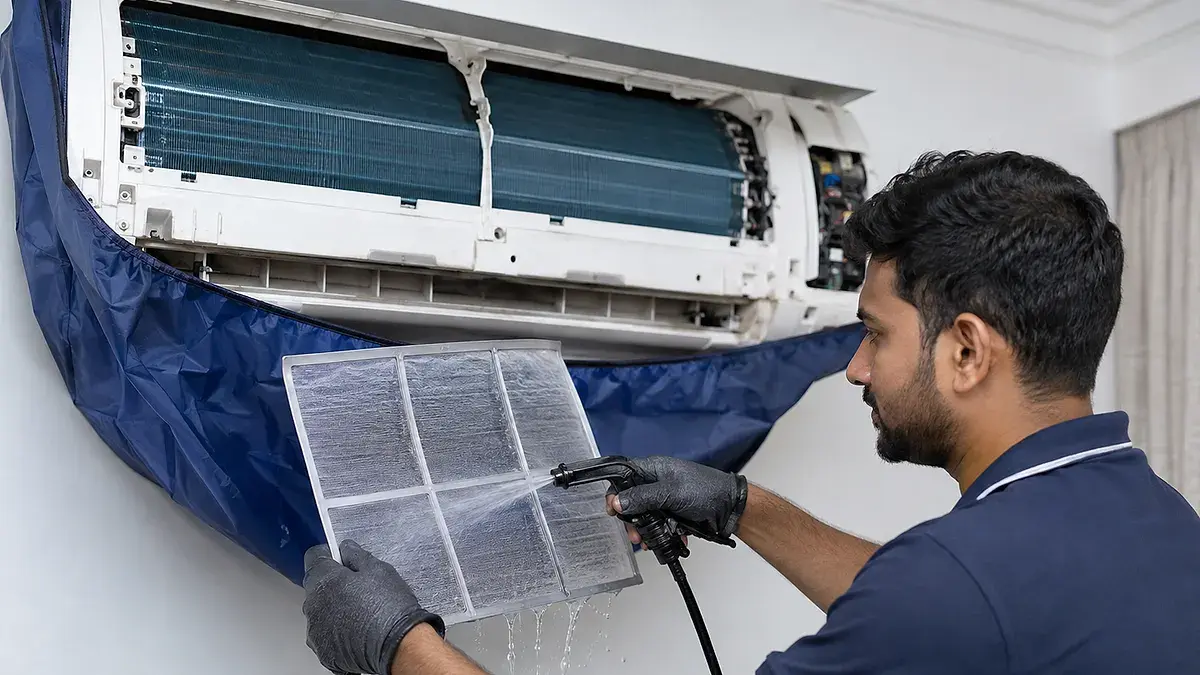
Inspect filter, evaporator, blower, condenser and fan delivery.
Control and electrical tests
Check sensors, modes, supply and component operation.
Cooling-cycle evidence
Use temperatures, pressures and current in context before repair or refrigerant action.
Slow-cooling patterns and useful next checks
One symptom can have several causes. Use the pattern, timing and accompanying signs to narrow the next test instead of replacing parts from a guess.
The table is a decision aid, not a substitute for model-specific procedures, safe instruments or manufacturer service information.
| Observation | Possible area | Next check |
|---|---|---|
| Slow only after hot afternoon closure | Stored room heat | Shade, ventilate safely before cooling, monitor trend |
| Weak air at outlet | Filter, blower, coil or ice | Restore airflow and diagnose |
| Good air but high room heat | Envelope or capacity | Review roof, glass, gaps and sizing |
| Performance declined suddenly | Equipment or circuit fault | Compare readings and service history |
Switch the system off when there is burning smell, smoke, repeated breaker tripping, water near wiring or unsafe access. Do not bypass a protection device.
How should the result be verified?
The final test should reproduce the original operating condition as closely as practical and show whether the reported problem is resolved.
Record the work completed, relevant readings, parts used and any remaining limitation so a future visit starts with evidence rather than assumptions.
- Airflow is clean, strong and well directed.
- Room-load assumptions are recorded.
- Temperature and comfort improve steadily.
- Outdoor operation remains stable at peak conditions.
- Any capacity limitation is separated from a repair fault.
From first observation to verified handover
- 1
Establish a baseline
Record start temperature, settings, weather and room load.
- 2
Reduce avoidable load
Close gaps, shade strong sun and limit unnecessary heat sources.
- 3
Inspect airflow
Check filters, fans, coils and outdoor clearance.
- 4
Diagnose equipment
Measure electrical, control and cooling-cycle performance.
- 5
Repeat comparable test
Verify the improvement under a similar operating period.
Share useful details before the visit
Send the model, AC type, location, symptom timing, settings, error code and a short video where useful. Mention recent cleaning, shifting, electrical work, refrigerant work or power events.
Ask for an itemised scope that separates inspection, cleaning, labour, parts, refrigerant and follow-up tests. Keep the service report for warranty and repeat-fault history.
Ask what is included, what is excluded, which findings support additional work and how the final result will be tested.
Common mistakes to avoid
- Judging cooling from a few minutes after a heat-soaked start.
- Selecting 16°C to make the compressor cool faster.
- Increasing tonnage without assessing the room heat load.
- Approving work without asking how the final result will be tested and recorded.
Frequently asked questions
How long should an AC take to cool a room?
There is no universal time. Capacity, start temperature, humidity, room construction, sun, occupancy and equipment condition all affect pull-down.
Does setting 16°C cool the room faster?
It usually changes the target, not the AC's maximum available capacity. Use a comfortable set point and address load or performance causes.
Can humidity make cooling feel slow?
Yes. The AC removes moisture as well as sensible heat, and high humidity can delay comfort even while temperature falls.
Should I buy a larger AC for faster cooling?
Only after a heat-load assessment. Oversizing can create cycling and humidity-control problems.
When does slow cooling need repair?
Seek diagnosis when performance has clearly declined, airflow is weak, ice or errors appear, the outdoor unit stops, or the room never approaches comfort under reasonable load.
Talk to Turbo Cooling Solutions
Share your location, AC type and requirement for a clear service response.