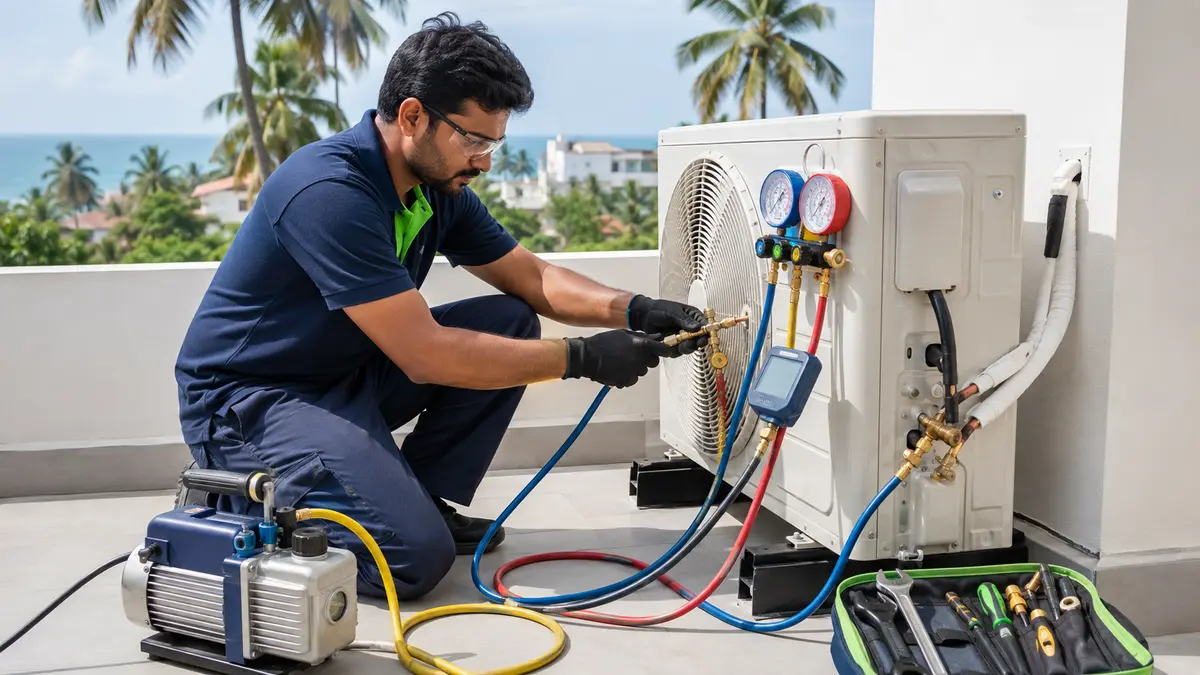
What should you expect?
Vacuuming—or evacuation—removes air and water vapour from newly installed or opened refrigerant piping before the specified refrigerant is released or charged. Skipping it can leave non-condensable gas and moisture that affect pressure, oil stability, capacity and reliability. A vacuum does not replace a separate leak-integrity test.
Leak test first; evacuate second; charge and verify last
Hot, humid coastal air carries moisture into open copper piping quickly. In Pondicherry and Cuddalore especially, installers should keep pipe ends sealed during work, complete sound joints, prove leak integrity and then evacuate with clean, suitable equipment.
These commissioning stages answer different questions. A pressure test checks whether the field piping holds safely. Evacuation removes air and moisture. Charging establishes the model-specified refrigerant mass. Operating checks confirm the system delivers the intended result.
Humidity makes open-pipe discipline more important, but “vacuum for a fixed number of minutes” is not a universal quality test. Pipe length, pump condition, hose arrangement, moisture and the manufacturer procedure all affect the result.
How to recognise a credible evacuation process
Pipes stayed sealed
Copper ends were capped until connection, limiting humid air, dust and debris entering the circuit.
Leak integrity came first
The installer completed the specified leak test before relying on vacuum readings.
Vacuum was measured
A suitable vacuum gauge and clean, correctly sized hoses were used—not only the manifold pressure scale or elapsed time.
Isolation was observed
The system was isolated and the vacuum response checked as required to reveal leaks, trapped moisture or service-equipment issues.
What quality AC evacuation and commissioning includes
Correct installation manual
Use the exact outdoor and indoor model instructions, specified refrigerant and permitted line dimensions.
Clean, dry piping
Keep copper capped, use suitable tube preparation and prevent water, scale and debris from entering.
Approved joints
Make flares or brazed joints with specified materials, torque and procedures.
Separate leak test
Prove piping integrity by the manufacturer-approved pressure and inspection process.
Suitable vacuum equipment
Use a maintained vacuum pump, clean oil, low-loss connections and a gauge intended to measure evacuation.
Vacuum verification
Reach and hold the target defined by the equipment procedure; avoid assuming one universal time is adequate.
Correct refrigerant release or charge
Open service valves or weigh additional charge only after installation requirements are satisfied.
Commissioning record
Verify cooling, airflow, drainage, controls, sound and relevant readings, then record the result.
Pressure testing, evacuation and charging solve different problems
One reading cannot prove every part of the refrigerant circuit is clean, dry, leak-free and correctly charged.
| Stage | Primary purpose | What it does not prove alone |
|---|---|---|
| Leak test | Checks field-piping integrity | Does not remove air or moisture |
| Evacuation | Removes air and water vapour | Does not prove every pressure-dependent leak |
| Charge | Restores specified refrigerant mass | Does not repair a leak or blockage |
| Operating test | Confirms system response | Does not replace installation records |
Installation shortcuts that deserve a question
Ask for clarification if the installer proposes using the compressor to purge air, releases refrigerant as a flushing method or treats a short timer as the only evacuation proof.
- No model manual is consulted.
- Open copper ends are left exposed.
- No separate leak test is recorded.
- Vacuum is judged only by a compound gauge.
- Cooling is not verified after start-up.
A professional split AC commissioning sequence
- 1
Prepare and connect
Route clean, capped copper and drainage, then make model-approved joints.
- 2
Test leak integrity
Inspect and pressure-test field connections using the specified safe procedure.
- 3
Evacuate the circuit
Connect suitable equipment, remove air and moisture and verify the target.
- 4
Release or weigh charge
Follow factory-charge and additional-charge rules for the actual pipe length.
- 5
Commission the system
Run and record cooling, airflow, drainage, controls, sound and final connections.
Include vacuuming in the quotation and handover—not as an invisible extra
Before installation, ask whether leak testing, vacuum pump use, vacuum measurement, drain testing and commissioning are included. This makes quotations easier to compare.
For office projects, document circuit identity, pipe length, additional refrigerant, test result and commissioning data so future service teams are not guessing.
If an existing system was opened for coil, compressor or pipe repair, the repaired circuit also requires leak integrity, evacuation and correct charging before return to service.
Ask what is included, what is excluded, which findings support additional work and how the final result will be tested.
Common mistakes to avoid
- Purging air with refrigerant instead of evacuating.
- Using evacuation as the only leak test.
- Leaving pipe ends open in humid or dusty air.
- Judging vacuum only by time.
- Starting the AC without drain and performance checks.
- Approving work without asking how the final result will be tested and recorded.
How local conditions change the decision
Equipment model, building use and measured condition remain the primary inputs. Local heat, humidity, salt, dust, access and operating hours then shape the installation and maintenance plan.
Pondicherry
Coastal humidity, salt exposure, dense development and long cooling hours make drainage, outdoor airflow, corrosion condition and service access important planning inputs.
Villupuram
Strong daytime heat and seasonal dust increase the value of correct capacity, clean heat exchangers, protected pipework and practical preventive maintenance.
Cuddalore
Salt-laden air, monsoon moisture and commercial coastal exposure call for corrosion-aware equipment selection, sound mounting and documented inspections.
Chidambaram
Warm humid weather and mixed residential, institutional and business use require realistic occupancy, moisture, drainage and operating-hour assumptions.
Frequently asked questions
Is vacuuming necessary for every new split AC installation?
Field refrigerant piping should be evacuated according to the exact equipment installation instructions before commissioning. Factory-sealed packaged circuits are different.
How long should AC vacuuming take?
There is no reliable universal time. Pipe volume, moisture, pump, oil, hoses, temperature and target all matter. Follow the manufacturer procedure and measure the result.
Can a vacuum test find refrigerant leaks?
Vacuum behaviour can reveal a problem, but it is not a complete substitute for the specified pressure leak test. The two procedures serve different purposes.
What happens if moisture remains in an AC system?
Moisture can react with oil or refrigerant, contribute to acids, ice or restrictions and reduce long-term reliability. Proper clean work and evacuation limit this risk.
Can the AC compressor be used as a vacuum pump?
No. Use suitable evacuation equipment and the manufacturer commissioning procedure. Do not run the compressor with an improperly prepared circuit.
Should vacuuming be repeated after a refrigerant repair?
If the sealed circuit was opened, it should be leak-tested, evacuated and charged according to the service procedure before operation.
Talk to Turbo Cooling Solutions
Share the equipment model, site location, operating pattern and exact concern. Turbo Cooling Solutions can inspect the installation or system condition and explain the evidence before recommending work.