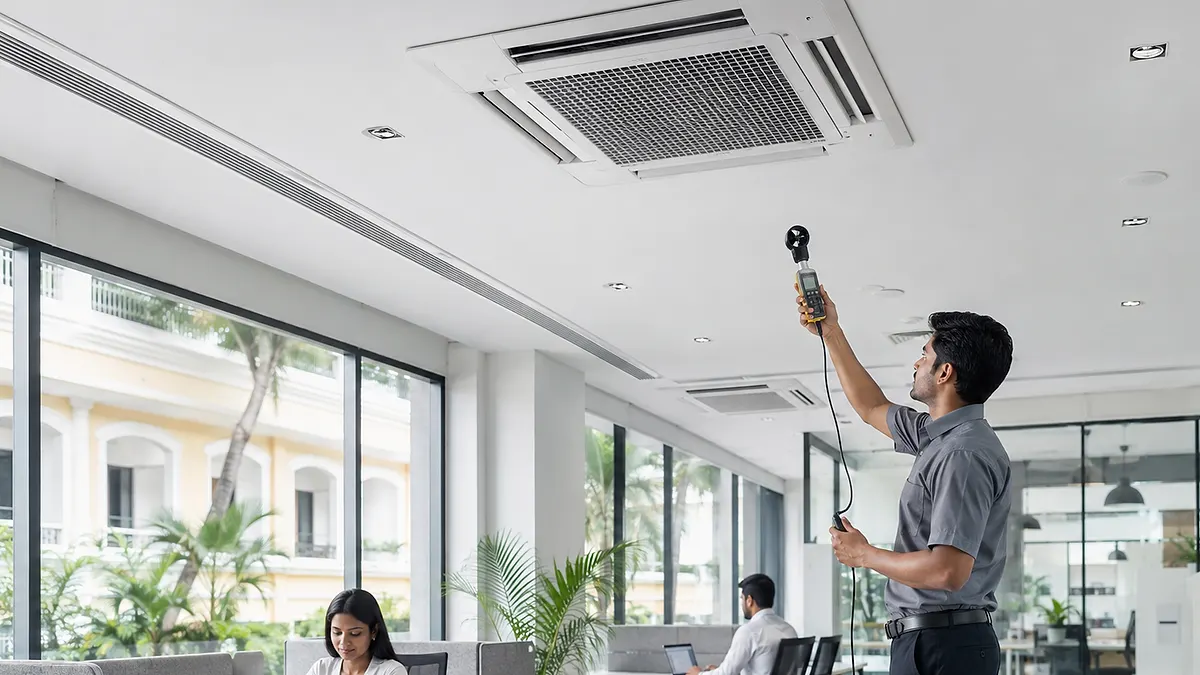
How is uneven ductable AC cooling corrected?
Ductable AC air balancing distributes the designed airflow to each room or zone. Correct balancing starts by confirming clean filters, fan and coil condition, open outlets, sound ducts and suitable return air; technicians then measure airflow or pressure and adjust dampers systematically instead of guessing by room temperature alone.
Air balancing is a controlled testing and adjustment process
Uneven cooling does not always mean the AC lacks capacity. One zone may receive too little supply air, another may have poor return air, or the duct may leak, collapse or become restricted. Heat load and control settings must be reviewed with airflow.
Closing random diffusers can increase noise and pressure without sending the correct airflow elsewhere. A competent assessment documents the design intent where available, fan condition, external static pressure, outlet airflow, damper positions, return path and room loads before final adjustment.
Pondicherry commercial buildings may combine humid outdoor air, coastal corrosion, long operating hours and frequent layout changes. Closed partitions, altered diffusers and added heat-producing equipment can disturb a system that once felt balanced.
Three checks before changing damper positions
Balancing cannot correct a mechanical fault or damaged duct until that problem is resolved.
Equipment airflow
Confirm filters, coil, blower, fan speed, belt where applicable and total system airflow are suitable before distributing air.
Duct integrity
Inspect accessible ducts, flexible connections, insulation, leakage, collapsed sections and closed fire or volume-control dampers.
Room and return path
Review occupancy, sunlight, equipment heat, partition changes, door position, diffuser placement and return-air access.
What a professional airflow-balancing visit should include
System baseline
Record filters, coil, fan, controls, total airflow indicators and equipment condition before adjustment.
Outlet measurements
Identify and measure supply outlets using suitable instruments and consistent test conditions.
Return-air review
Confirm adequate return paths and investigate doors, partitions or grilles that isolate a zone.
Final schedule
Document outlet results, damper positions, unresolved load issues and the final comfort verification.
Different room complaints point to different airflow problems
A room with weak air at every outlet may have a branch restriction, closed damper or leakage. Strong airflow but poor comfort may point to high heat load, supply-air temperature or diffuser placement. Noise at an outlet may indicate excessive velocity or restriction.
Test under repeatable operating conditions. Comparing rooms at different times, door positions or occupancy levels can produce misleading results.
| Observed complaint | Check first | Possible correction |
|---|---|---|
| Weak airflow in one branch | Damper, duct and outlet | Repair restriction or rebalance |
| Strong air but room stays warm | Load and supply-air condition | Address load, controls or capacity |
| Whistling or high outlet noise | Velocity and restriction | Correct outlet, damper or duct condition |
| Room changes when door closes | Return-air path | Provide suitable return-air solution |
Fire dampers and life-safety components must never be altered as ordinary balancing dampers.
Record the final airflow condition for future maintenance
A balancing report provides a baseline for later complaints, renovations and filter changes. It should identify outlets, test conditions, results, damper settings and deviations from design where known.
Rebalancing may be needed after partitions, ceilings, equipment, occupancy or operating schedules change. Regular maintenance keeps the filters, coils and fan condition close to the state in which balancing was completed.
- Label outlets and zones consistently.
- Record test conditions and fan settings.
- Keep before-and-after readings.
- Review the system after interior renovation.
From complaint mapping to balanced operation
- 1
Map every complaint
Record hot, cold, noisy and low-airflow zones under normal occupancy.
- 2
Restore equipment condition
Correct dirty filters, coils, fan defects and obvious duct damage first.
- 3
Measure the system
Check total and outlet airflow or relevant pressures under stable test conditions.
- 4
Adjust systematically
Change appropriate dampers in a controlled sequence and remeasure affected outlets.
- 5
Document and verify
Record final settings and confirm comfort without unacceptable noise or pressure.
Information the facility team should prepare
Provide drawings where available, room use, operating schedules, recent renovations, known damper locations, complaint history and any previous balancing report. Ensure ceiling and plant access can be arranged safely.
Ask the service provider to distinguish equipment repair, duct repair, testing and balancing, insulation work and control changes in the quotation.
Ask what is included, what is excluded, which findings support additional work and how the final result will be tested.
Common mistakes to avoid
- Closing random diffusers without measuring system response.
- Balancing with dirty filters or a faulty fan.
- Ignoring return-air paths and changed room heat loads.
- Approving work without asking how the final result will be tested and recorded.
Frequently asked questions
What is ductable AC air balancing?
It is the measured adjustment of airflow distribution so each room or zone receives an appropriate share of the system's available air under defined operating conditions.
Can closing one AC vent improve another room?
Randomly closing vents can increase noise and pressure without creating correct distribution. Dampers and airflow should be adjusted systematically and remeasured.
Why is one room warm even when airflow feels strong?
The room may have higher sunlight, occupancy or equipment load, unsuitable diffuser placement, warm supply air or insufficient total capacity. Air quantity is only one part of diagnosis.
When should ductable AC be rebalanced?
Consider rebalancing after renovations, partition changes, diffuser changes, major fan or duct work, persistent uneven comfort or when measured airflow no longer matches the required distribution.
What should an air-balancing report contain?
It should identify zones and outlets, test conditions, measured results, damper positions, equipment settings, deviations and final verification.
Talk to Turbo Cooling Solutions
Share your location, AC type and requirement for a clear service response.