What should you expect?
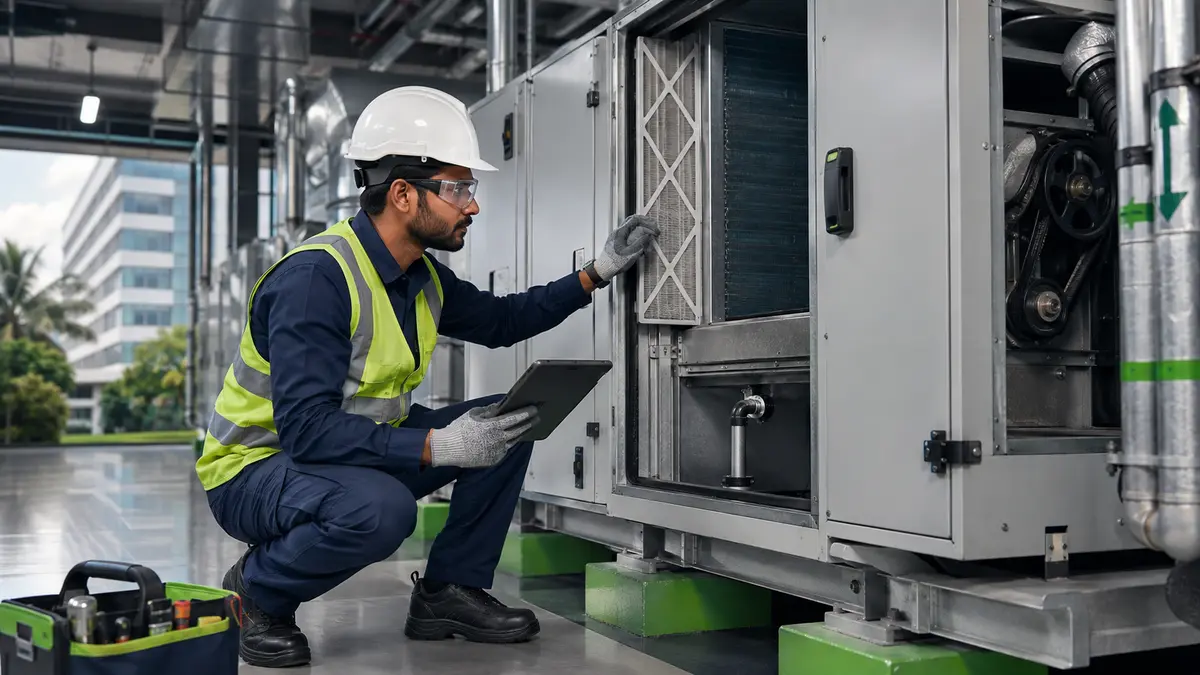
A commercial HVAC checklist should identify every asset, set tasks and intervals from manufacturer guidance, operating hours, environment and failure consequence, then record condition and measured results. At minimum, cover filters, coils, fans, drives, drains, refrigerant-circuit evidence, electrical condition, controls, airflow or water flow, safety devices, corrosion, housekeeping and corrective actions.
Manage maintenance as an asset system, not a cleaning visit
Coastal commercial buildings around Pondicherry and Cuddalore may need closer corrosion, drain and coil-condition review; dusty or high-hour sites around the wider region may load filters and condensers faster. The calendar should adapt to actual condition.
Each task needs an asset ID, responsible person, safe method, acceptable condition, evidence and escalation rule. A completed tick without readings, findings or corrective action does not show that the system can meet comfort, energy and indoor-air objectives.
Monsoon moisture, salt and rooftop exposure can change deterioration between otherwise identical units. Add site-specific corrosion, drainage, weather sealing and insulation checks to the base manufacturer schedule.
Set maintenance priority from risk and evidence
Frequency is not one-size-fits-all; criticality and condition determine where effort goes first.
Criticality
Rank server rooms, business-critical zones, public areas and comfort-only spaces by consequence of failure.
Operating exposure
Use run hours, occupancy, dust, salt, humidity, grease, outdoor heat and water quality to adjust tasks.
Condition trend
Compare temperatures, current, alarms, pressure, flow, vibration, energy and repeat complaints against baselines.
Failure history
Increase root-cause work on assets with recurring drain, leak, electrical, control or corrosion problems.
Commercial HVAC preventive maintenance checklist
Asset and safety controls
Verify asset ID, model, isolators, guards, access, permits, lockout process and outstanding hazards before work.
Filters and indoor airflow
Inspect pressure drop or condition, replace or clean approved filters and check return, supply, blower and diffuser restrictions.
Coils and heat rejection
Inspect evaporator and condenser cleanliness, fin damage, corrosion, fan operation and free outdoor airflow.
Condensate and moisture
Clean and test pans, drains, traps, pumps, floats, insulation and overflow response.
Electrical and mechanical
Inspect terminals, contactors, protection, capacitors where used, motors, bearings, belts, pulleys, vibration and mounts safely.
Refrigerant circuit
Look for oil, corrosion, ice, damaged insulation and abnormal operating evidence; leak-test before charging when justified.
Controls and sensors
Verify schedules, set points, sensors, actuators, safeties, alarms, interlocks, BMS points and after-hours overrides.
Performance and records
Record representative temperatures, current, pressure or flow as applicable, run hours, energy, complaints, findings and corrective actions.
Daily, monthly, seasonal and annual tasks should fit the asset
The table is a programme framework, not a universal manufacturer schedule. Adjust it for equipment documentation, operating data and applicable requirements.
| Review layer | Typical owner or contractor activity | Evidence |
|---|---|---|
| Routine operator | Alarms, sound, leaks, temperatures, access and complaints | Shift or weekly log |
| Condition inspection | Filters, drains, coils, corrosion and operating readings | Asset checklist and photos |
| Seasonal readiness | Peak-load capacity, controls, heat rejection and critical spares | Pre-season report and open actions |
| Annual programme review | Failure trends, energy, lifecycle and scope adequacy | Updated plan and budget |
A good checklist creates decisions, not paperwork
Trend the same meaningful readings under comparable conditions. Define acceptable ranges from design, manufacturer and commissioning data rather than generic internet values.
- Use one asset ID on equipment, controller and records.
- Photograph repeat corrosion or leaks from the same angle.
- Separate observed condition from recommended work.
- Assign owner, due date and status to every corrective action.
- Verify the result after repair.
Build a maintainable commercial HVAC programme
- 1
Create the asset register
List equipment, location, model, capacity, refrigerant, controls, criticality, warranty and documents.
- 2
Define tasks and triggers
Combine manufacturer schedules with run hours, site exposure, condition and failure consequence.
- 3
Establish baselines
Retain commissioning and healthy-operation data for temperatures, flow, current, alarms, energy and comfort.
- 4
Execute and correct
Complete safe inspections, prioritise findings and repair root causes with verification.
- 5
Review and improve
Analyse repeat failures, overdue actions, energy drift and downtime, then update scope and budget.
What a commercial HVAC maintenance report should show
The report should identify the asset, date, run condition, work completed, measurements, photos, defects, urgency, safety status, recommendation, quotation boundary and verification result.
Separate preventive tasks from corrective repair. This prevents a “service completed” label from hiding an unresolved failed pump, corroded bracket, leak or control alarm.
Review the programme before peak summer and after major occupancy, fit-out, control or equipment changes. Maintenance should follow the current building—not an old static contract.
Ask what is included, what is excluded, which findings support additional work and how the final result will be tested.
Common mistakes to avoid
- Using one identical checklist for every asset.
- Cleaning filters without checking coils, drains or controls.
- Recording only “OK” with no condition or measurement.
- Adding refrigerant as routine maintenance.
- Closing the visit without owners and due dates for defects.
- Approving work without asking how the final result will be tested and recorded.
How local conditions change the decision
Equipment model, building use and measured condition remain the primary inputs. Local heat, humidity, salt, dust, access and operating hours then shape the installation and maintenance plan.
Pondicherry
Coastal humidity, salt exposure, dense development and long cooling hours make drainage, outdoor airflow, corrosion condition and service access important planning inputs.
Villupuram
Strong daytime heat and seasonal dust increase the value of correct capacity, clean heat exchangers, protected pipework and practical preventive maintenance.
Cuddalore
Salt-laden air, monsoon moisture and commercial coastal exposure call for corrosion-aware equipment selection, sound mounting and documented inspections.
Chidambaram
Warm humid weather and mixed residential, institutional and business use require realistic occupancy, moisture, drainage and operating-hour assumptions.
Frequently asked questions
How often should commercial HVAC be maintained?
Use the manufacturer schedule, operating hours, environment, condition and criticality. High-hour, dusty, coastal or critical assets may need more frequent review.
What is included in commercial AC preventive maintenance?
A good scope covers safety, filters, coils, fans, drains, electrical and mechanical condition, controls, refrigerant evidence, performance readings, records and corrective actions.
Should refrigerant top-up be part of every maintenance visit?
No. Refrigerant is not consumed routinely. Add it only after diagnosis, leak integrity, repair where needed and the model-specified charge process.
What should a facility manager check between contractor visits?
Monitor alarms, comfort complaints, unusual sound or smell, water, access obstruction, schedules, run hours and energy trends without opening hazardous equipment.
Why are commissioning readings useful for maintenance?
They provide a healthy baseline. Future readings can reveal drift in airflow, controls, heat transfer, energy or capacity before a total failure.
Does preventive maintenance guarantee no breakdowns?
No. It reduces avoidable risk and can reveal developing faults, but random failures and external events can still occur. Resilience planning is also needed.
Talk to Turbo Cooling Solutions
Share the equipment model, site location, operating pattern and exact concern. Turbo Cooling Solutions can inspect the installation or system condition and explain the evidence before recommending work.