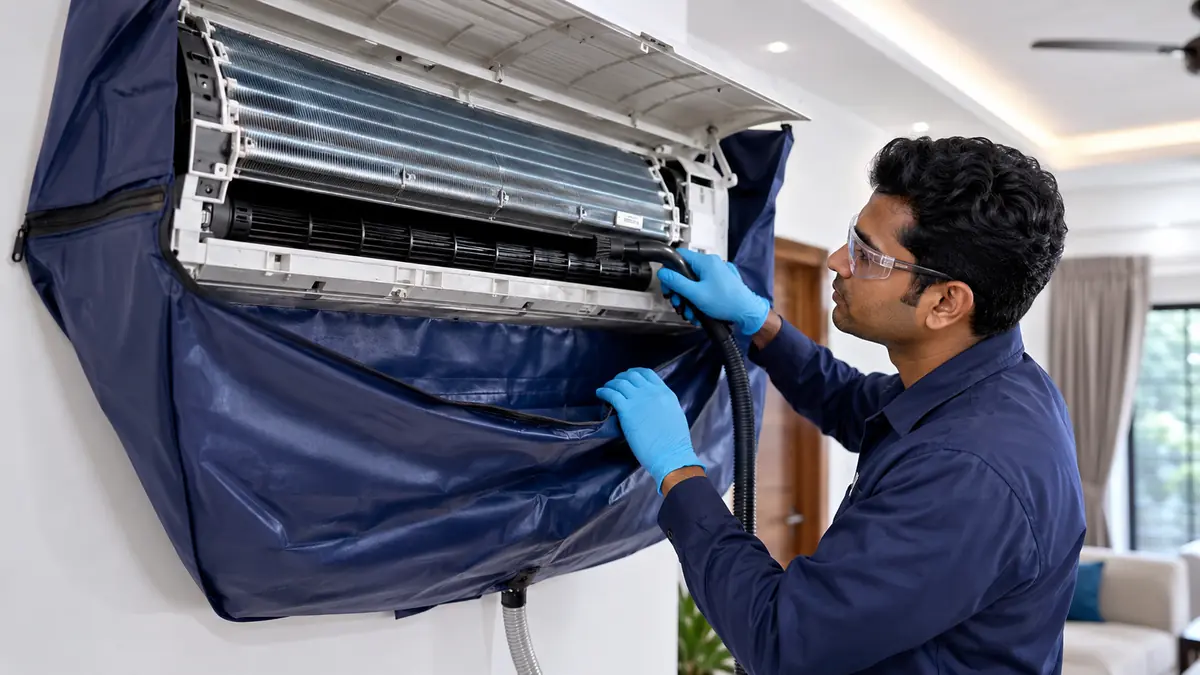
Should your AC receive wet service or dry service?
Dry service is usually suitable for inspection, filter cleaning and loose surface dust. Wet service is considered when washable coil, blower, tray or condenser surfaces have adhered dirt that dry cleaning cannot remove. The technician should inspect first, isolate power, protect electronics and the room, use model-safe pressure and verify drainage before choosing either method.
Use the least aggressive safe method that solves the confirmed problem
Wet and dry service describe cleaning methods, not fixed quality levels. The right method depends on where contamination is located, whether the material is safe to wash, the unit design, room protection and the original cooling or drainage complaint.
Ask the technician to show the dirt, state which components will be cleaned and explain how the PCB, motors, sensors, wall and furniture will be protected. A wet wash does not repair refrigerant leaks, electrical faults or worn parts, while a dry service may be insufficient for sticky deposits or drain-tray slime.
Pondicherry's coastal humidity can make dust adhere to damp indoor surfaces and salt exposure can affect outdoor units. Climate raises the need for inspection, but it does not mean every AC should be washed at every visit.
Three questions decide the cleaning method
A method should be selected after access and condition are checked—not from a one-price menu alone.
Is the dirt loose or adhered?
Dry brushing or vacuuming may handle accessible loose dust. Oily, sticky or compacted deposits may require controlled wet cleaning if the component permits it.
Can water be safely contained?
Wet work needs power isolation, electronic protection, a service bag or equivalent containment and a clear route for wastewater.
What is the actual fault?
Weak airflow may improve with cleaning, but icing, sensor faults, fan defects or refrigerant problems require diagnosis beyond washing.
What to confirm before a wet or dry AC service
Inspection evidence
Confirm the condition of the filter, evaporator, blower, drain tray, drain line and outdoor coil before approving the method.
Water and electrical protection
For wet work, require isolation, sealed protection for electronics and controlled collection of wash water.
Pressure and chemicals
Ask what pressure and cleaner will be used and whether they are compatible with coil fins, coatings and plastic parts.
Final run test
Verify airflow, cooling response, fan sound, drainage, controls and absence of indoor leakage after reassembly.
Wet and dry cleaning solve different contamination levels
Dry service limits moisture and is useful for accessible filters, loose dust and visual inspection. It can be quicker, but it should not be represented as a deep clean when deposits remain on the blower or coil.
Wet service uses controlled water or approved cleaning solution on washable areas. It requires more preparation, containment and drying, and its benefit depends on reaching the contaminated component without harming electronics or delicate fins.
| Decision point | Dry service | Wet service |
|---|---|---|
| Best suited to | Loose, accessible dust | Adhered washable contamination |
| Moisture control | Minimal | Isolation and containment required |
| Typical access | Filters and accessible surfaces | Coil, tray, blower or condenser as scoped |
| Does not replace | Deep cleaning or fault diagnosis | Leak, electrical or parts diagnosis |
Never direct high-pressure water at a PCB, connector, sensor, motor bearing or delicate coil fin. The equipment manual and technician's risk assessment should govern the method.
How can you tell whether the selected method worked?
The outcome should be measured at the complaint point: airflow, odour, water drainage, cooling response or outdoor heat rejection. A shiny cover is not proof that the blocked component was cleaned.
If the symptom remains after a safe clean, stop repeating washes and move to diagnosis. Record the remaining symptom, operating observations and any recommendation that needs approval.
- Airflow is unobstructed and stable.
- Condensate reaches the outdoor discharge without overflow.
- No electrical compartment is damp.
- The original odour or dirt complaint is reassessed after drying.
- Unresolved faults are written separately.
From condition check to dry, tested handover
- 1
Inspect
Record the complaint and examine the air path, drainage and accessible electrical areas.
- 2
Select and explain
Choose dry, wet or combined cleaning component by component and explain protection and exclusions.
- 3
Clean safely
Isolate power, protect the site and electronics, control pressure and collect debris or wastewater.
- 4
Reassemble and test
Dry protected areas, restore panels and verify airflow, cooling, controls and drainage.
Describe the symptom instead of requesting a method blindly
Tell the service company about weak airflow, odour, water leakage, visible dirt and the last service date. This allows the technician to bring appropriate containment and cleaning equipment.
For occupied offices, clinics, shops or rented homes, agree on furniture protection, wastewater handling, access, drying time and a final service record before work begins.
Ask what is included, what is excluded, which findings support additional work and how the final result will be tested.
Common mistakes to avoid
- Assuming wet service is automatically better for every unit.
- Washing before power isolation or without protecting electronics.
- Using excessive pressure that bends coil fins.
- Treating cleaning as a substitute for refrigerant or electrical diagnosis.
- Approving work without asking how the final result will be tested and recorded.
Frequently asked questions
Is wet AC service always better than dry service?
No. Wet cleaning is useful for suitable washable surfaces with adhered contamination. Dry cleaning may be adequate for accessible loose dust. Inspection, component design and safety determine the method.
Can wet service damage an AC?
It can if water reaches electronics, pressure bends fins, unsuitable chemicals are used or components are not dried and reassembled correctly. Controlled protection and model-safe methods reduce the risk.
Does wet service include gas filling?
No. Cleaning and refrigerant work are separate. Refrigerant should be assessed only when diagnostic evidence indicates a circuit problem, and any leak should be addressed before charging.
Which method helps a musty AC smell?
The source must be found. A contaminated filter, coil, blower, tray or drain may need appropriate cleaning, but room moisture, stagnant drainage or another source may also contribute.
How often should wet cleaning be done in Pondicherry?
There is no responsible fixed interval for every AC. Decide from usage, dust and humidity exposure, filter condition, airflow, drainage and visible internal contamination.
Talk to Turbo Cooling Solutions
Share your location, AC type and requirement for a clear service response.