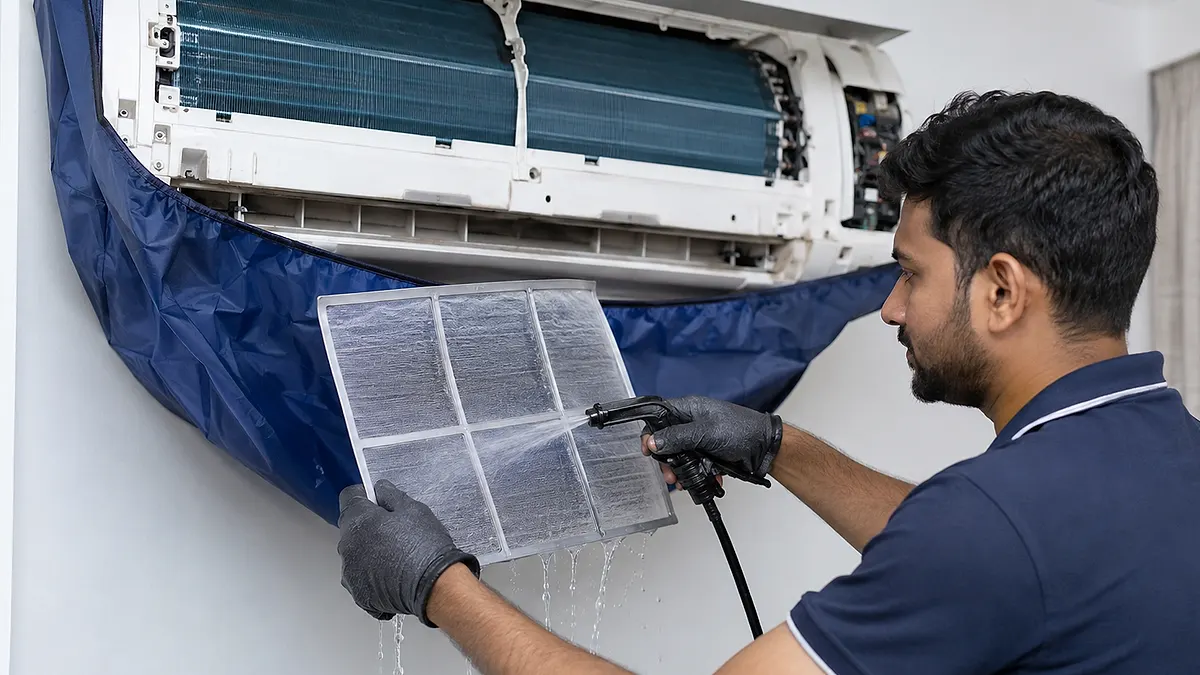
Should you book general service or deep cleaning?
Choose general AC service when the unit needs routine inspection, accessible filter cleaning, drainage checks and performance verification. Consider deep cleaning only when inspection finds heavy coil or blower contamination, persistent odour, restricted airflow, drain fouling or dirt that routine access cannot remove.
The cleaning level should match what the technician finds
General service and deep cleaning solve different maintenance needs. A professional decision starts by inspecting filters, the evaporator face, blower, drain tray, drain line and outdoor coil, then checking airflow, cooling response, odour and water flow.
Deep cleaning should not be sold automatically at every visit. Ask the technician to show the contamination, explain which components require access or dismantling, protect electrical parts and test cooling and drainage after reassembly. Refrigerant charging and parts replacement are separate jobs that require their own diagnosis.
Pondicherry's humid coastal air can combine fine dust, moisture and salt exposure. This can load filters, support deposits on wet indoor surfaces and accelerate outdoor corrosion, but the correct cleaning scope should still be based on inspection rather than climate alone.
Three checks that determine the right cleaning scope
These checks help separate routine maintenance from a genuinely intensive cleaning requirement.
Airflow and contamination
Inspect the filter, evaporator surface and blower. A clean filter with weak airflow may indicate deeper contamination, fan trouble, icing or another fault.
Odour and drainage
Persistent musty smell, slime in the tray or repeated water overflow can justify deeper indoor cleaning and drain treatment after the cause is confirmed.
Performance evidence
Compare cooling response, airflow and operating behaviour before and after work. Cleaning is useful when dirt is restricting heat transfer or air movement, but it will not repair a failed sensor, fan, capacitor or compressor.
What a transparent cleaning quotation should explain
Components included
Confirm whether the scope covers filters, evaporator coil, blower wheel, louvers, drain tray, drain line and outdoor condenser coil.
Cleaning method
Ask whether cleaning is dry, low-pressure wet cleaning, pump-assisted washing or dismantling, and how walls, furniture and electronics will be protected.
Faults excluded
Clarify that refrigerant leaks, electrical defects, damaged insulation and replacement parts are diagnosed and quoted separately.
Final verification
Require a run test covering airflow, cooling response, drainage, controls, leakage and unusual sound before handover.
General AC service and deep cleaning are not the same job
General service is a preventive visit built around inspection, accessible cleaning and operational checks. It is suitable when contamination is light and the AC has no evidence of deep blower, coil or drainage fouling.
Deep cleaning is a condition-based corrective cleaning scope. It normally requires more protection, access and drying time because the technician may need to reach heavily contaminated internal surfaces. The exact method must remain compatible with the model and site.
| Decision point | General service | Deep cleaning |
|---|---|---|
| Typical reason | Routine preventive care | Heavy or inaccessible contamination |
| Indoor scope | Accessible filters and inspection | Coil, blower, tray and drain as condition requires |
| Best evidence | Light dirt and stable airflow | Visible deposits, odour, weak airflow or drain fouling |
| Not automatically included | Parts and refrigerant work | Parts, leak repair and refrigerant work |
Do not approve chemical or high-pressure cleaning without confirming that it is safe for the coil coating, electronics, drain system and surrounding property.
How do you know the cleaning worked?
A visually clean cover is not enough. The useful result is unrestricted airflow, stable cooling response, clear condensate drainage, normal fan sound and no water escaping into the room.
Ask for before-and-after photographs of inaccessible contamination where practical. If cooling remains poor after airflow is restored, continue with electrical, control and refrigerant-circuit diagnosis instead of repeating the wash.
- Airflow is stronger and evenly directed.
- Water drains outside without tray overflow.
- No electrical area was left wet.
- The original odour or contamination complaint is reassessed after drying.
- Any remaining fault is documented separately.
From inspection to verified handover
- 1
Record the complaint
Note airflow, cooling, odour, leakage, previous cleaning and daily operating hours.
- 2
Inspect before washing
Open accessible sections and identify the actual dirt location, drainage condition and electrical risks.
- 3
Agree on the scope
Explain why general service or deep cleaning is appropriate and list everything included.
- 4
Protect and clean
Isolate power, protect the room and electronics, use a model-appropriate method and control wastewater.
- 5
Dry, run and verify
Reassemble the unit and confirm airflow, cooling, drainage, controls and sound.
Information that helps the technician choose correctly
Share the AC type, age, last service date, daily usage, cooling complaint, odour, visible water leakage and whether the blower or coil appears heavily dirty. A photograph can help plan access but does not replace inspection.
Request an itemised quotation and do not accept refrigerant charging as part of routine cleaning unless measured diagnosis and leak assessment support it.
Ask what is included, what is excluded, which findings support additional work and how the final result will be tested.
Common mistakes to avoid
- Selecting deep cleaning only because it has a higher price or stronger name.
- Allowing water near the PCB, motor connectors or unprotected wall sockets.
- Assuming every cooling problem will be corrected by washing.
- Approving work without asking how the final result will be tested and recorded.
Frequently asked questions
Is deep cleaning necessary at every AC service in Pondicherry?
No. Deep cleaning should follow visible or measurable evidence such as heavy coil or blower deposits, persistent odour, restricted airflow or drainage contamination. Light routine dirt may only require general service and accessible cleaning.
Does deep cleaning include AC gas filling?
Not automatically. Refrigerant work is separate from cleaning. Low refrigerant should be supported by diagnosis, and the system should be checked for a leak before charging is recommended.
Can AC deep cleaning fix weak cooling?
It can help when weak cooling is caused by restricted airflow or dirty heat-transfer surfaces. It will not correct electrical, sensor, compressor, fan or refrigerant-circuit faults.
How should the room be protected during wet cleaning?
The technician should isolate power, cover electrical sections, use a wash bag or controlled collection method, protect walls and furniture and prevent wastewater from reaching sockets or finishes.
How can I compare AC cleaning quotations?
Compare the components included, cleaning method, dismantling required, room protection, exclusions and final performance checks rather than comparing only the package name or price.
Talk to Turbo Cooling Solutions
Share your location, AC type and requirement for a clear service response.