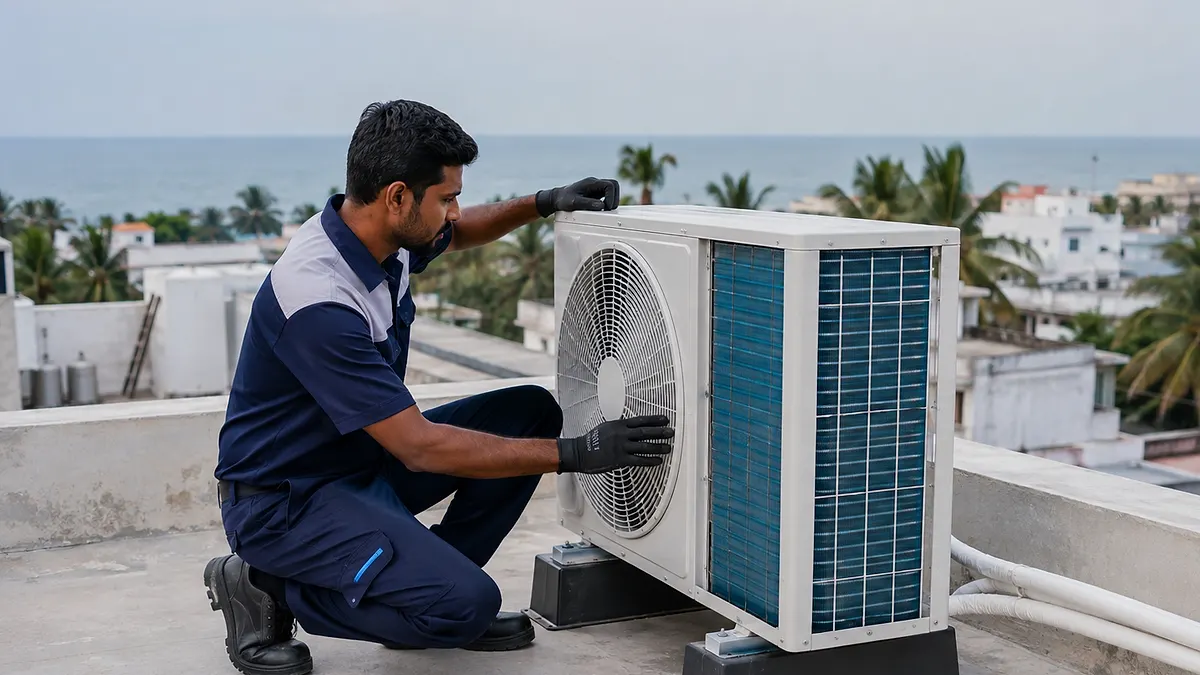
What should you check before restarting an unused AC?
After a long unused period, inspect the AC before extended operation. Check for damaged wiring, pests, corrosion, loose mounting, blocked airflow, dirty filters, drain obstruction and outdoor-unit blockage. Start briefly under observation, confirm normal sound and drainage, then assess cooling performance instead of immediately demanding gas filling.
Inspect first, then run the system under observation
An idle AC can collect dust, insect nests and drain blockages, while insulation and metal parts continue to age. A safe restart separates visible hazards from normal start-up behaviour and creates a baseline for further diagnosis.
Do not energize a unit with chewed cable, a wet electrical enclosure, burning smell, loose outdoor mounting or signs that pests entered the controls. Cleaning and preventive checks may be enough when the unit was healthy before storage, but faults found during the start-up test should be diagnosed separately.
Closed properties in Pondicherry can trap humidity while outdoor units remain exposed to coastal air, rain, vegetation and salt. These conditions can affect terminals, fins, insulation and drainage even when the AC has not operated.
Three risk areas deserve attention after storage
These checks reduce avoidable water, electrical and mechanical problems at restart.
Electrical and pest condition
Inspect accessible cables, isolator, plugs, terminals and enclosures for damage, moisture, nests or corrosion before applying power.
Airflow and drainage
Clean or replace filters as required, clear obstructions around both units and confirm the drain route is intact and open.
Observed start-up
Run in cooling mode while watching for unusual sound, smell, vibration, error codes, indoor water leakage and outdoor-unit operation.
What an after-storage AC service should cover
Indoor visual inspection
Check filter, coil face, blower area, louvers, wiring access, drain tray and signs of insects or mould-like deposits.
Outdoor condition
Check mounting, vegetation, airflow clearance, coil condition, terminals and pipe insulation.
Drain test
Confirm condensate can travel through the line without indoor overflow or unsafe discharge.
Performance record
Document start-up behaviour, airflow, cooling response, controls, sound and any measured findings relevant to a fault.
Idle time creates different risks from operating wear
A unit does not need an automatic overhaul simply because it was unused. The service scope should respond to exposure and observed condition.
Extended disuse can still allow filters to collect dust, drain water seals to dry, pests to enter, terminals to corrode and outdoor clearance to disappear behind vegetation or stored items.
| Finding | Safe response | Do not assume |
|---|---|---|
| Dusty filter | Clean or replace as designed | That refrigerant is low |
| Blocked drain | Clear and test route | That the indoor coil is leaking |
| Corroded terminal | Isolate and assess repair | That cleaning alone is enough |
| Weak cooling | Check airflow and diagnose | That gas filling is the first step |
If the breaker trips, wiring smells hot, water reaches electrical areas or the compressor repeatedly fails to start, switch the unit off and arrange qualified diagnosis.
What should you observe during the first cooling cycle?
Set a realistic temperature and allow the unit to stabilize. Listen for steady fan and compressor operation, check that airflow is not restricted and look for condensate reaching the intended outdoor drain point.
A room that has been closed and heat-soaked may cool slowly at first. Judge the AC using operating evidence and room conditions, not a few minutes of outlet air alone.
- No burning or sharp electrical smell.
- No repeated tripping or rapid stop-start cycle.
- Indoor air movement is steady.
- Drainage appears only at the intended outlet.
- No new error code or abnormal vibration.
A controlled four-step return to service
- 1
Survey the site
Check equipment, cables, mounting, pipe insulation, drainage and outdoor clearance without energizing.
- 2
Restore basic condition
Clean filters, remove safe external obstructions and address visible damage before operation.
- 3
Start under observation
Use cooling mode and monitor controls, fan, compressor, sound, smell and drainage.
- 4
Record and escalate
Document normal results or isolate the system and diagnose any unsafe or persistent symptom.
Plan the visit before occupants or stock return
For homes or rentals, schedule the check early enough to clean, dry and test the unit before occupancy. For shops and offices, include every AC in an asset list so unused rooms are not missed.
If the building was closed after flooding, roof leakage, renovation or pest treatment, tell the technician. Those events change the inspection scope and may require electrical or indoor-air-quality specialists beyond routine AC service.
Ask what is included, what is excluded, which findings support additional work and how the final result will be tested.
Common mistakes to avoid
- Running the AC despite damaged wiring or a wet enclosure.
- Ignoring a blocked drain until water enters the room.
- Requesting refrigerant without diagnosis.
- Judging performance before clearing airflow and allowing stable operation.
- Approving work without asking how the final result will be tested and recorded.
Frequently asked questions
Does an AC need service after six months unused?
It should at least be inspected and restarted carefully. The required cleaning or repair depends on storage conditions, dust, pests, corrosion, drainage and its condition before shutdown.
Can I switch on an unused AC immediately?
First check for visible cable damage, moisture, nests, blocked outdoor airflow and loose mounting. Stop and obtain qualified help if anything appears unsafe.
Will AC gas disappear while the unit is unused?
A sealed refrigerant circuit does not consume refrigerant during storage. Low charge indicates leakage or prior service loss and should be diagnosed before charging.
Why does an unused AC smell when restarted?
Dust, stagnant drainage, contamination on wet surfaces or room odours may contribute. Find and clean the source safely rather than masking it with fragrance.
What should commercial sites record at restart?
Record asset identity, visual condition, filter and drain status, start-up result, errors, readings used for diagnosis, work completed and follow-up priority.
Talk to Turbo Cooling Solutions
Share your location, AC type and requirement for a clear service response.