What should you expect?
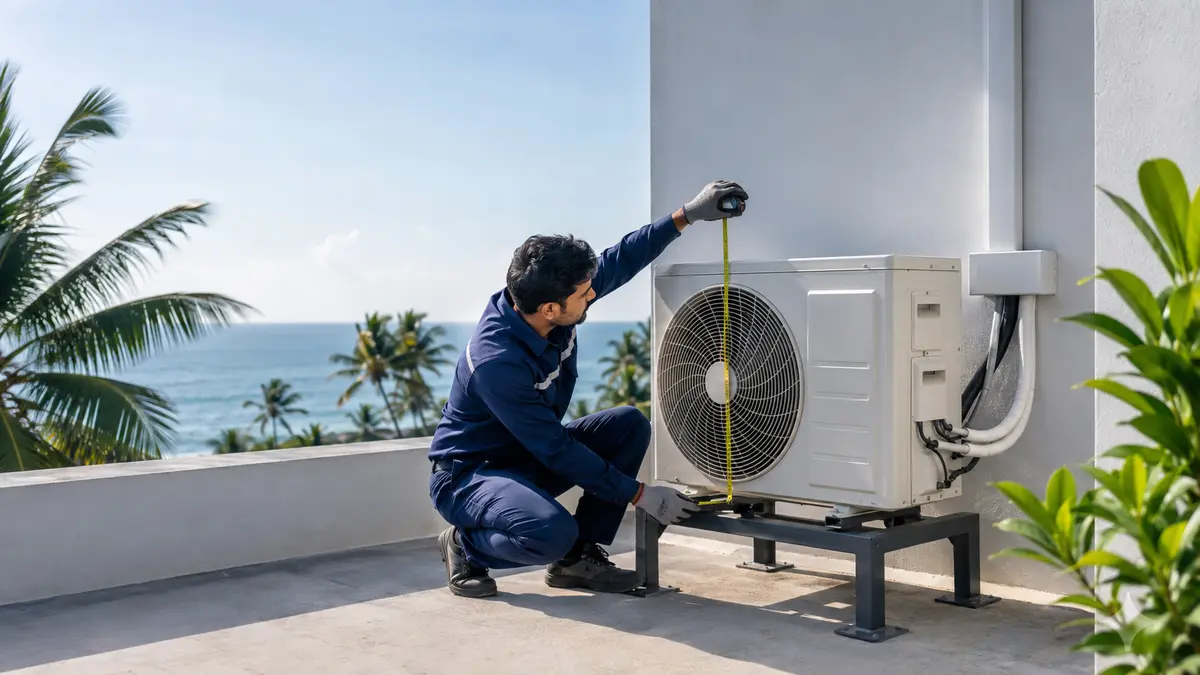
The best outdoor-unit position has the exact manufacturer clearances, an unobstructed intake and discharge, a level structural support, safe electrical and pipe routing, controlled drainage and practical service access. Avoid sealed cabinets, narrow hot shafts and arrangements where one condenser blows into another.
Give the condenser cool incoming air and somewhere for hot air to go
Pondicherry and Cuddalore add salt and monsoon exposure; Villupuram adds heat and dust. Placement must balance airflow, corrosion risk, rain, direct sun, neighbour impact, access and the actual building structure.
An outdoor unit moves large volumes of air through its coil. When hot discharge recirculates into the intake, operating conditions worsen. A decorative screen or shade is acceptable only when it preserves the model-required airflow and service envelope.
Coastal protection is not achieved by boxing the unit. Choose corrosion-suitable equipment, maintain drainage and coatings, rinse or clean only as recommended and keep the coil open to air.
Evaluate the proposed location from four directions
Air path
Map intake and hot discharge air, nearby walls, screens, parapets and other condensers.
Structure and vibration
Confirm load capacity, anchor method, level support, isolation and resistance to wind or accidental impact.
Service access
Provide safe reach to panels, valves, coil, fan, electrical isolator and future removal path.
Environment and neighbours
Review salt, rain, sun, dust, drain water, sound, vibration and hot air affecting windows or people.
Outdoor condenser placement checklist
Manufacturer clearances
Use the exact model diagrams for rear, side, front, top and multi-unit spacing; no single dimension fits every AC.
Free discharge
Keep hot air from striking a close wall, screen, roof or opposing condenser and returning to the coil.
Stable support
Use a level, corrosion-appropriate stand or bracket designed for unit weight, vibration and site exposure.
Service envelope
Leave room for panels, instruments, coil cleaning, fan or compressor work and safe replacement.
Pipe and cable protection
Support lines, seal wall entries, protect insulation and avoid sharp edges, standing water and sun damage.
Drain management
Route condensate or defrost water where applicable without creating slippery surfaces, stains or nuisance.
Sound and vibration
Avoid lightweight partitions, bedroom windows and structures that amplify vibration; verify mounting after start-up.
Coastal inspection access
Make the coil, base, fasteners and brackets visible enough for regular corrosion checks and maintenance.
Balcony, roof, wall bracket or service yard?
Every option can work when structure, airflow, access and environment are designed together.
| Location | Potential advantage | Primary risk to manage |
|---|---|---|
| Open balcony | Convenient access | Hot-air recirculation and neighbour impact |
| Roof | Open airflow and grouped services | Sun, wind, waterproofing and safe access |
| Wall bracket | Keeps unit above ground water | Structural anchor and work-at-height access |
| Service yard | Dedicated maintenance space | Crowding, screens and multiple-unit airflow |
Shade can help the setting, but airflow matters more
A roof or screen should not short-circuit airflow or block service. Never attach an unapproved cover that interferes with the fan discharge or traps heat.
- Keep the air outlet open.
- Allow wind-driven rain drainage.
- Use corrosion-resistant supports.
- Check multi-unit separation.
- Keep plants and stored items outside the service envelope.
Select and commission an outdoor-unit location
- 1
Read the model layout rules
Confirm clearances, weight, pipe limits, sound data and permitted orientation.
- 2
Survey the structure
Check support, anchors, waterproofing, access, fall risk and route to the indoor unit.
- 3
Model the air path
Review discharge direction, obstacles, wind, multiple units and future screens or construction.
- 4
Install with protected services
Level and secure the unit, then support pipe, insulation, cable and drain routes.
- 5
Verify under operation
Check vibration, sound, hot-air recirculation, drainage, temperatures and service reach.
Plan for maintenance and replacement on day one
A unit may fit into a niche but still be unserviceable. Allow tools, panel removal and a safe lifting or replacement route so routine work does not require dismantling the building.
For banks of commercial condensers, coordinate row spacing, discharge direction, service walkways, pipe supports and access control. One unit's hot air must not become another unit's intake.
In coastal buildings, include bracket, fastener, coil and base-pan inspections in maintenance. Repair coating damage and drainage problems before corrosion becomes structural.
Ask what is included, what is excluded, which findings support additional work and how the final result will be tested.
Common mistakes to avoid
- Boxing the condenser inside a decorative enclosure.
- Using a universal clearance number instead of the model manual.
- Mounting where service panels cannot open.
- Allowing one outdoor unit to blow into another.
- Ignoring bracket corrosion and wall condition.
- Approving work without asking how the final result will be tested and recorded.
How local conditions change the decision
Equipment model, building use and measured condition remain the primary inputs. Local heat, humidity, salt, dust, access and operating hours then shape the installation and maintenance plan.
Pondicherry
Coastal humidity, salt exposure, dense development and long cooling hours make drainage, outdoor airflow, corrosion condition and service access important planning inputs.
Villupuram
Strong daytime heat and seasonal dust increase the value of correct capacity, clean heat exchangers, protected pipework and practical preventive maintenance.
Cuddalore
Salt-laden air, monsoon moisture and commercial coastal exposure call for corrosion-aware equipment selection, sound mounting and documented inspections.
Chidambaram
Warm humid weather and mixed residential, institutional and business use require realistic occupancy, moisture, drainage and operating-hour assumptions.
Frequently asked questions
How much space should be left around an AC outdoor unit?
Use the exact model installation diagram. Required rear, side, front and top clearances change with unit design, obstacles and single- or multi-unit layout.
Can an AC outdoor unit be installed in a closed balcony?
Only if the design provides the required intake, discharge and heat removal. A glazed or screened balcony can trap hot air and reduce performance.
Should an outdoor AC unit be shaded?
A suitable shade may reduce direct sun or weather exposure, but it must not restrict airflow, drainage or service. Follow the model instructions.
Can the outdoor unit be placed higher than the indoor unit?
Often yes within the exact system's permitted vertical separation and piping rules. Confirm height, length and any oil-management requirements.
Why is my outdoor unit very hot?
The unit rejects indoor heat, so warm discharge is normal. Blocked airflow, dirty coils, hot-air recirculation or a technical fault can make operating conditions abnormal.
What is different about coastal outdoor-unit placement?
Salt exposure increases corrosion risk. Keep free airflow, choose suitable materials or coatings, provide inspection access and maintain brackets, fasteners, coils and drains.
Talk to Turbo Cooling Solutions
Share the equipment model, site location, operating pattern and exact concern. Turbo Cooling Solutions can inspect the installation or system condition and explain the evidence before recommending work.