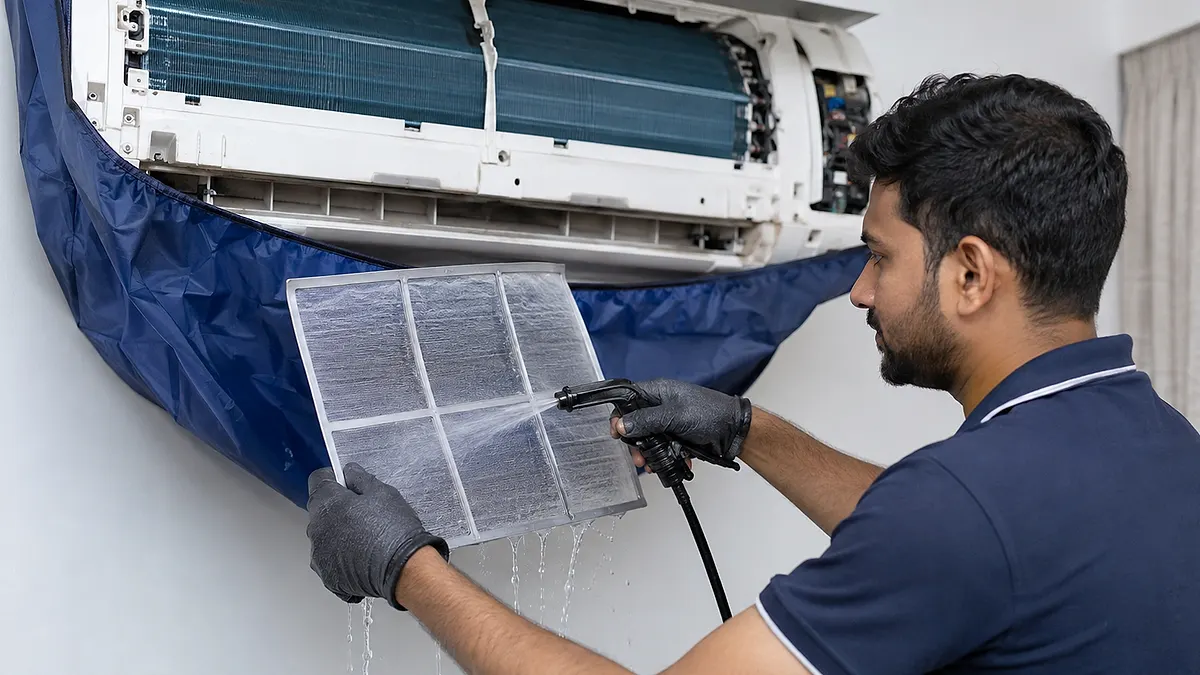
How often should a dusty-home AC be serviced?
Dusty roadside homes need more frequent condition checks, especially for washable filters, indoor airflow and the outdoor coil, but service frequency should follow actual loading rather than a fixed monthly deep clean. Inspect filters regularly, clean them by the manufacturer method, keep doors and windows closed during heavy dust, protect outdoor airflow and schedule professional coil, blower and drain cleaning when visible deposits or performance evidence justify it.
Increase inspection frequency before increasing cleaning intensity
Fine road and construction dust can pass through open doors, settle on filters and mix with moisture on indoor surfaces. Outdoor coils can also collect lint and debris that reduce heat rejection.
Check the filter every few weeks during the dustiest period and record how quickly it loads. Villupuram road conditions, floor level and household habits vary, so build a schedule from airflow, deposits and operating hours. Avoid harsh chemicals or high pressure that damage coils.
Villupuram homes and businesses can face strong seasonal heat, roadside dust and variable operating schedules. Filter loading, outdoor airflow and electrical conditions should be checked with the reported symptom.
What to check before approving work
Start with safe, observable conditions and move to model-specific technical tests only when the evidence requires them.
Filter loading rate
Compare filter condition after a known number of operating weeks.
Airflow and dust trails
Watch for weaker delivery, dirt at louvers and deposits on the blower or coil face.
Outdoor contamination
Inspect safe visible coil surfaces and clearance without covering the unit.
Professional checks for Dust-Exposure AC Maintenance
Filter care
Clean or replace only by filter type and manufacturer instruction.
Indoor deep inspection
Assess evaporator, blower, tray and drain when surface filter cleaning no longer restores condition.
Outdoor coil
Use controlled, fin-safe cleaning and preserve ventilation.
Maintenance record
Track dates, condition, airflow complaint and cleaning scope to set the next interval.
Use condition signals to choose maintenance depth
One symptom can have several causes. Use the pattern, timing and accompanying signs to narrow the next test instead of replacing parts from a guess.
The table is a decision aid, not a substitute for model-specific procedures, safe instruments or manufacturer service information.
| Finding | Likely action | Avoid |
|---|---|---|
| Light filter dust | Manufacturer-approved filter cleaning | Automatic deep dismantling |
| Blower deposits and weak flow | Professional internal inspection/clean | Only washing the cover |
| Outdoor coil blocked | Fin-safe condenser cleaning | Close high-pressure spray |
| Dust returns immediately | Review room leakage and source | Cleaning repeatedly without source control |
Wear appropriate protection and avoid disturbing unknown construction dust, bird waste or hazardous material. Specialist cleaning may be needed.
How do you know the dusty-home service worked?
The final test should reproduce the original operating condition as closely as practical and show whether the reported problem is resolved.
Record the work completed, relevant readings, parts used and any remaining limitation so a future visit starts with evidence rather than assumptions.
- Filter fits correctly without bypass gaps.
- Airflow is restored and even.
- Blower and coil condition match the approved scope.
- Drain carries water freely.
- Outdoor fins remain open and undamaged.
From first observation to verified handover
- 1
Record exposure
Note road activity, construction, open windows and operating hours.
- 2
Inspect filters regularly
Build an interval from actual loading.
- 3
Control indoor dust entry
Improve closure and cleaning practices without blocking ventilation needs.
- 4
Service by condition
Clean deeper components only when inspection supports it.
- 5
Trend the result
Track airflow and loading to refine the schedule.
Share useful details before the visit
Send the model, AC type, location, symptom timing, settings, error code and a short video where useful. Mention recent cleaning, shifting, electrical work, refrigerant work or power events.
Ask for an itemised scope that separates inspection, cleaning, labour, parts, refrigerant and follow-up tests. Keep the service report for warranty and repeat-fault history.
Ask what is included, what is excluded, which findings support additional work and how the final result will be tested.
Common mistakes to avoid
- Deep-cleaning on a calendar without checking condition.
- Operating without the correct filter.
- Using high pressure that folds coil fins.
- Approving work without asking how the final result will be tested and recorded.
Frequently asked questions
How often should I clean an AC filter in a dusty Villupuram home?
Inspect it frequently during dusty periods and clean by manufacturer guidance when loaded. The correct interval depends on exposure and operating hours.
Can I use the AC without a filter for stronger airflow?
No. Running without the designed filter can contaminate the coil and blower and harm indoor cleanliness.
Does a dirty filter increase electricity use?
Restriction can reduce airflow and performance, causing longer or less effective operation. Other system conditions also affect energy.
Should the outdoor unit be covered from road dust?
Do not cover it while operating. Maintain open airflow and use installation or screening solutions only if manufacturer clearances remain intact.
When is deep cleaning justified?
When inspection finds internal deposits, weak airflow, odour, drainage fouling or contamination inaccessible to routine filter care.
Talk to Turbo Cooling Solutions
Share your location, AC type and requirement for a clear service response.