What should you expect?
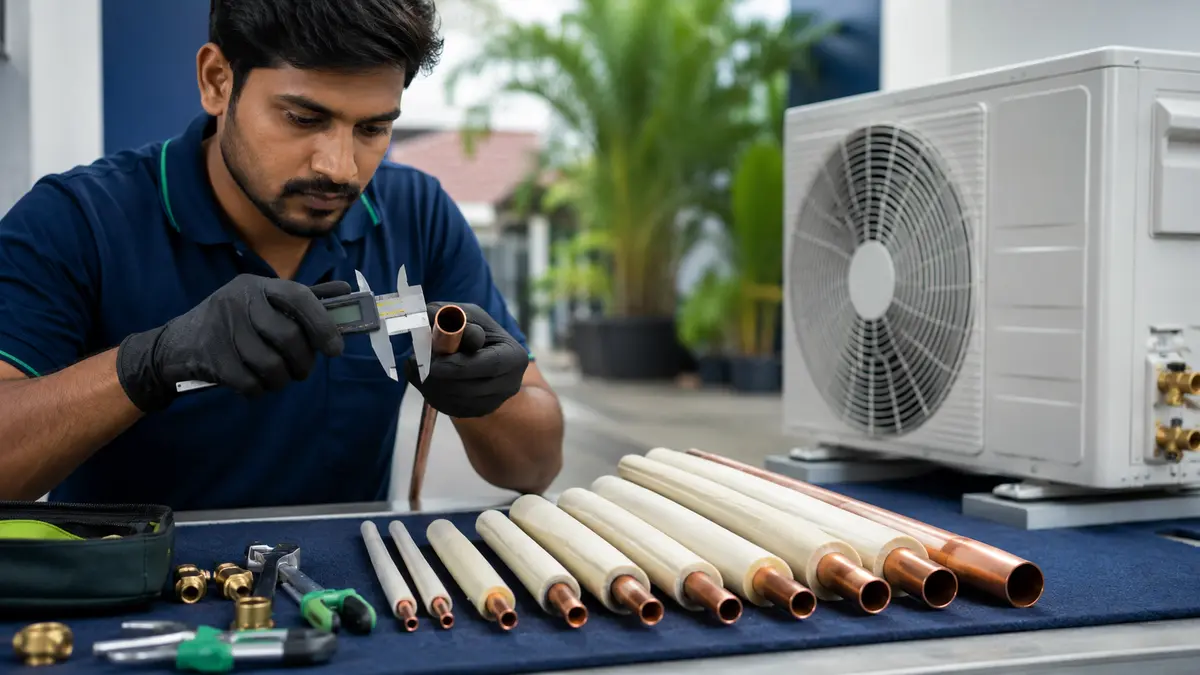
The correct AC copper pipe size is the exact liquid-line and gas-line diameter, material specification and thickness stated for the indoor–outdoor unit combination. Generic “one pipe size per ton” rules can be wrong. An undersized, oversized, excessively long, kinked or poorly insulated line can change pressure drop, refrigerant velocity, oil return, charge requirement and delivered capacity.
Size the line set from the model manual and actual route
Coastal heat and long daily operation make installation losses easier to notice. Across Pondicherry and nearby Tamil Nadu, pipe runs also need protection from salt, sun, roof heat, wall abrasion and trapped rainwater—not only the right nominal diameter.
Confirm both connected unit models, refrigerant, liquid and gas sizes, maximum total length, height difference, factory-charge allowance and additional-charge rule before copper is purchased or concealed.
Outdoor insulation exposed to coastal sun and salt can crack early. Use suitable closed-cell insulation, weather protection and supports so condensation, heat gain and copper abrasion do not undermine a correctly sized line.
Five installation details that must agree
Pipe diameter is only one part of refrigerant-line design.
Exact model pair
Indoor and outdoor model compatibility determines the approved liquid and gas line sizes.
Route length and lift
Measure actual equivalent length, bends and vertical separation before applying charge or layout limits.
Refrigerant and material
Use clean refrigeration-grade copper of the specified thickness and pressure suitability.
Joint and insulation quality
Correct flaring or brazing, torque, leak testing and continuous insulation are essential to the result.
AC copper line-set installation checklist
Liquid-line diameter
Match the manual value; do not assume both pipes should be the same size.
Gas-line diameter
Match the connected capacity and approved piping table for the exact model combination.
Copper wall and grade
Use refrigeration-grade, clean, dry copper with the required thickness and pressure rating.
Maximum length
Keep within total and equivalent-length limits, including fittings and branch arrangements where applicable.
Vertical separation
Respect height limits and any oil-management instructions for the system type.
Additional refrigerant
Apply the specified quantity only when the actual line length exceeds the factory allowance.
Insulation and vapour seal
Insulate suction and liquid lines as required, seal joints and protect outdoor insulation from weather and damage.
Supports and bend quality
Prevent kinks, flattened bends, vibration contact, water traps and unprotected wall penetrations.
What can happen when pipe dimensions or routing are wrong
The exact effect varies with system design; technicians should diagnose from model data and measurements rather than one symptom.
| Installation issue | Possible system effect | Correct response |
|---|---|---|
| Wrong diameter | Pressure drop, velocity or oil-return problems | Use the approved model piping table |
| Excess length or lift | Capacity loss or charge mismatch | Redesign route or select suitable equipment |
| Kinked or flattened tube | Flow restriction and abnormal operation | Replace the damaged section |
| Damaged insulation | Heat gain, condensation and water damage | Restore continuous sealed insulation |
Good copper can still fail at a poor joint
Flares need clean cutting, deburring, correct forming, alignment and specified torque. Brazed systems require an approved process that limits internal scale and protects nearby components.
- Never reuse a visibly damaged flare.
- Use two-wrench technique where specified.
- Keep water and debris out of the tube.
- Pressure-test every field joint before evacuation.
- Protect penetrations from abrasion and weather.
Plan and verify a refrigerant pipe route
- 1
Confirm equipment data
Record both model numbers, refrigerant, pipe sizes and installation limits.
- 2
Survey the route
Measure length, lift, bends, access, drainage interaction and outdoor exposure.
- 3
Prepare clean materials
Select correct copper, insulation, supports, trunking and joint materials.
- 4
Install and test
Form sound joints, support the run and complete the approved leak test and evacuation.
- 5
Charge and document
Apply any model-specified additional charge and record length, charge and commissioning results.
Questions to answer before copper is concealed
Can every joint be tested and, where practical, kept accessible? Concealed joints and buried unprotected copper make future leak diagnosis and repair more disruptive.
Does the route share a chase with drainage or electrical services? Coordinate slope, insulation thickness, fire stopping, access and separation before walls or ceilings close.
For VRF, multi-split and commercial systems, branch components, equivalent length and oil management require engineered manufacturer selection—not room-AC rules.
Ask what is included, what is excluded, which findings support additional work and how the final result will be tested.
Common mistakes to avoid
- Selecting pipe from tonnage alone.
- Ignoring actual length and vertical lift.
- Using plumbing copper or damaged reused tubing without approval.
- Leaving insulation joints open to humid air.
- Adding refrigerant without applying the model length rule.
- Approving work without asking how the final result will be tested and recorded.
How local conditions change the decision
Equipment model, building use and measured condition remain the primary inputs. Local heat, humidity, salt, dust, access and operating hours then shape the installation and maintenance plan.
Pondicherry
Coastal humidity, salt exposure, dense development and long cooling hours make drainage, outdoor airflow, corrosion condition and service access important planning inputs.
Villupuram
Strong daytime heat and seasonal dust increase the value of correct capacity, clean heat exchangers, protected pipework and practical preventive maintenance.
Cuddalore
Salt-laden air, monsoon moisture and commercial coastal exposure call for corrosion-aware equipment selection, sound mounting and documented inspections.
Chidambaram
Warm humid weather and mixed residential, institutional and business use require realistic occupancy, moisture, drainage and operating-hour assumptions.
Frequently asked questions
What copper pipe size is used for a 1.5-ton AC?
There is no universal answer. Read the exact indoor and outdoor model installation table because pipe sizes can differ by refrigerant, series and design.
Can a smaller AC copper pipe reduce cooling?
An unapproved smaller line can increase pressure drop or change refrigerant velocity and system operation. Use only the manufacturer-specified sizes.
Can I reuse an old AC copper pipe?
Only after confirming diameter, thickness, refrigerant compatibility, cleanliness, insulation, route, joint condition and manufacturer permission. Replacement is often safer when history is unknown.
Does a longer copper pipe need more refrigerant?
Many systems specify a factory-covered length and additional charge per metre beyond it. Use the exact model instruction; never guess.
Why do AC copper pipes need insulation?
Insulation limits heat gain and surface condensation. The required thickness and whether both lines are insulated depend on the system instructions and environment.
Can wrong pipe size damage the compressor?
Wrong sizing or routing can contribute to abnormal pressure, cooling, velocity or oil-return conditions. The risk depends on the system, so correct the installation and test operation.
Talk to Turbo Cooling Solutions
Share the equipment model, site location, operating pattern and exact concern. Turbo Cooling Solutions can inspect the installation or system condition and explain the evidence before recommending work.