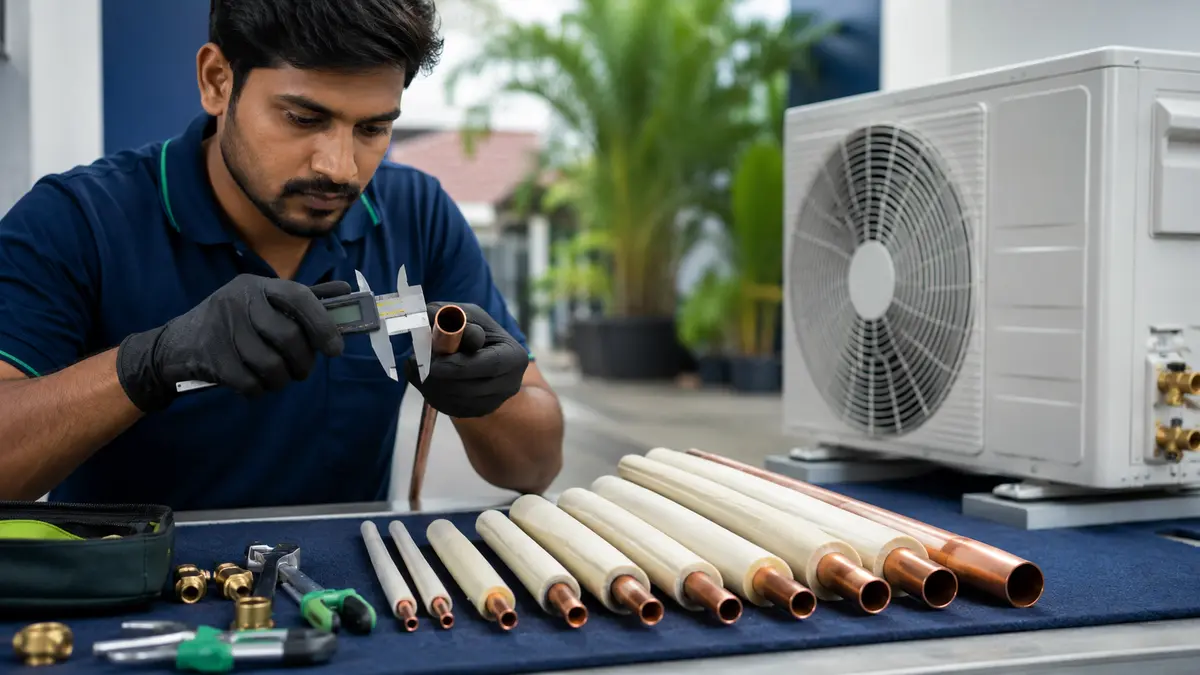
When is full AC copper-pipe replacement justified?
Replace an AC copper pipe when testing confirms widespread corrosion, inaccessible or repeated leaks, crushed or kinked tubing, unsuitable diameter or wall thickness, contaminated pipework, damaged flare ends that cannot be renewed safely, or a route that cannot meet installation requirements. A sound line with one accessible repairable defect may not require full replacement.
Find the leak and assess the whole line set before choosing a scope
Copper pipe carries refrigerant between indoor and outdoor units. Its diameter, cleanliness, wall condition, flare quality, insulation, route and length affect reliability. Repeated gas refilling without finding a leak does not answer whether repair or replacement is needed.
Ask for the leak-test method and location. Accessible joints, service valves and coils should be assessed because a leak elsewhere can be mistaken for a pipe failure. If replacement is chosen, specify compatible copper size and thickness, maximum route limits, flare or brazing method, insulation, supports, vacuum procedure and final leak test.
Pondicherry's salt-laden coastal air can accelerate external corrosion where copper, joints and insulation are exposed. Good insulation, sealed joints, protective routing and inspection of outdoor sections are important, but replacement should follow leak evidence and condition assessment.
Three findings shape the copper-pipe decision
The goal is a durable sealed circuit, not simply a new visible section of pipe.
Leak location and extent
One accessible defect may be repairable. Multiple pinholes, long concealed leakage or widespread corrosion can make full renewal more reliable.
Pipe specification
Check liquid and suction diameters, wall quality, route length, elevation and compatibility with the model and refrigerant.
Internal cleanliness
Burnout contamination, moisture, open storage or incompatible previous refrigerant work may require replacement or a manufacturer-approved cleaning strategy.
What AC copper-pipe replacement should specify
Diagnosis
Record leak-test findings and distinguish pipe, flare, valve and coil leaks.
Copper specification
State sizes, approximate length, material standard or grade and any fittings or joints.
Route and insulation
Define bends, supports, wall sleeves, UV/weather protection, insulation thickness and drain separation.
Commissioning
Include pressure or leak testing, evacuation, charge handling and final performance checks according to manufacturer requirements.
Repair, partial renewal and full replacement fit different conditions
An accessible flare leak may need a corrected flare rather than a new line set. A damaged exposed section may allow partial renewal if joints are made correctly and the remaining tube is sound.
Full replacement becomes more reasonable when integrity is uncertain across the route, the tubing is wrongly sized or badly kinked, concealed leakage cannot be isolated, or repeated repairs have not held.
| Condition | Likely option | Evidence required |
|---|---|---|
| Single faulty flare | Renew flare/joint | Confirmed joint leak and sound tube |
| Local exposed damage | Partial section repair | Accessible defect and healthy remaining line |
| Multiple pinholes/corrosion | Full replacement | Documented widespread condition |
| Wrong size or crushed route | Correct full route | Model specification and route survey |
Refrigerant handling, pressure testing and brazing involve safety and environmental requirements. They should be performed by trained personnel using appropriate procedures.
New copper still fails when installation details are poor
Correct tube does not compensate for poor flares, excessive bending, unsealed insulation joints or skipped evacuation. Moisture and non-condensable gases left inside can affect performance and reliability.
The line should be supported without rubbing, protected at wall penetrations and insulated continuously on the suction side as the manufacturer requires. Final records should identify line length and any additional charge used.
- Use model-specified diameters.
- Prevent debris and moisture entering open tube.
- Make joints with approved tools and procedure.
- Pressure/leak test before commissioning.
- Evacuate and verify according to manufacturer guidance.
From leak confirmation to commissioned line set
- 1
Locate and assess
Test the circuit and inspect accessible pipe, joints, valves and coils to define the leak extent.
- 2
Design the route
Confirm size, length, elevation, joint strategy, drainage interaction, insulation and access.
- 3
Install cleanly
Protect tube interiors, form bends correctly, make approved joints and seal insulation.
- 4
Test and commission
Leak-test, evacuate, manage charge correctly and document final operation.
Copper-pipe price depends on more than the visible metre rate
Compare quotes using the same diameters, approximate route length, insulation, casing, wall work, joints, supports, testing, refrigerant handling and access equipment. A low metre rate can omit the steps that determine reliability.
For concealed pipes, discuss whether the route can be tested and accessed, whether a new surface route is preferable and who restores walls or false ceilings. Obtain approval before destructive access.
Ask what is included, what is excluded, which findings support additional work and how the final result will be tested.
Common mistakes to avoid
- Refilling refrigerant repeatedly without locating the leak.
- Replacing the line before checking coils, valves and flares.
- Using the wrong diameter or poorly insulated copper.
- Skipping leak testing or evacuation after installation.
- Approving work without asking how the final result will be tested and recorded.
Frequently asked questions
How do I know my AC copper pipe is leaking?
Cooling loss or oil marks may suggest a leak, but confirmation needs an appropriate leak test across pipework, joints, valves and coils. Low cooling alone is not proof.
Can an AC copper-pipe leak be repaired?
Some accessible localized defects or flare leaks can be repaired if the surrounding tube is sound and the method suits the refrigerant circuit. Widespread corrosion or repeated leaks may justify replacement.
Should old copper be reused during AC relocation?
Only after size, condition, cleanliness, length and insulation are checked against the new installation. Kinked, contaminated or unsuitable tubing should not be reused.
Why does copper-pipe insulation matter in Pondicherry?
Proper closed insulation helps control condensation and heat gain. Sealed, weather-resistant finishing also protects exposed sections in humid coastal conditions.
Does new copper pipe include refrigerant gas?
Not automatically. The quote should separately explain recovery, leak testing, evacuation, factory-charge limits and any additional refrigerant required by the model and line length.
Talk to Turbo Cooling Solutions
Share your location, AC type and requirement for a clear service response.