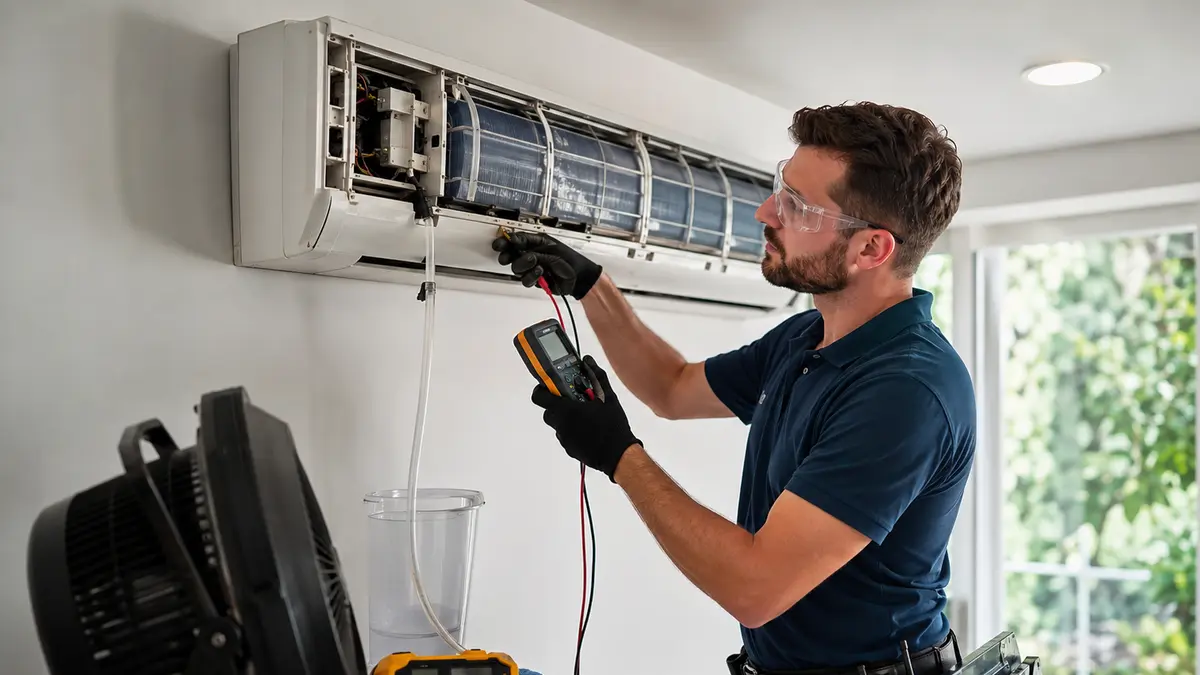
Why is the AC running without cooling the room?
When an AC runs but the room stays warm, first confirm Cool mode, a sensible set point, closed doors and windows, clean filters and unrestricted supply and return airflow. Then verify that the outdoor unit operates and can reject heat. If the room remains warm, a technician should test fan performance, coil condition, sensors, electrical controls, installation capacity and the refrigerant circuit before recommending gas or parts.
Separate a room-load problem from an equipment fault
A running display and indoor fan do not prove that the complete cooling cycle is working. The compressor or outdoor fan may be stopped, airflow may be restricted, the room heat load may exceed capacity, or the refrigeration circuit may have a confirmed fault.
Record when the problem is worst, whether outlet air feels cool, whether the outdoor unit starts, how long the AC has run and whether the issue began after installation or service. In top-floor or west-facing Pondicherry rooms, afternoon heat can expose sizing and insulation limitations that are less visible at night.
Pondicherry combines hot-humid weather with coastal salt exposure, dense urban rooms and long summer operating hours. Inspect the actual installation and operating conditions instead of treating climate as proof of one fault.
Check settings, airflow and heat rejection first
These three groups explain many warm-room complaints and keep diagnosis in a logical order.
Settings and room closure
Use Cool mode, remove timers, choose a realistic set point and close doors, windows and major air gaps.
Indoor airflow
Check the filter, intake, louvers and airflow strength; ice or weak flow requires inspection before extended use.
Outdoor operation
Observe from a safe distance whether the outdoor fan and compressor appear to operate and whether discharge air is unobstructed.
What professional no-cooling diagnosis should include
Complaint and load review
Record room size, roof and sun exposure, occupancy, equipment capacity, settings and symptom timing.
Air-path inspection
Inspect filters, evaporator, blower, condenser and fan operation for restriction or contamination.
Electrical and control checks
Use model-specific tests for supply, sensors, boards, motors and compressor commands.
Refrigerant evidence
Assess pressures and temperatures with airflow, refrigerant type and operating conditions before any charge decision.
What different warm-room patterns can indicate
One symptom can have several causes. Use the pattern, timing and accompanying signs to narrow the next test instead of replacing parts from a guess.
The table is a decision aid, not a substitute for model-specific procedures, safe instruments or manufacturer service information.
| Observation | Possible area | Next check |
|---|---|---|
| Cool air but slow room response | High room load or low capacity | Review roof, sun, gaps and occupancy |
| Weak airflow | Filter, blower, coil or icing | Restore airflow and find ice cause |
| Indoor fan only | Outdoor electrical or control issue | Qualified outdoor-unit diagnosis |
| Cooling faded after earlier gas fill | Possible unresolved leak | Leak-test before recharging |
Switch the system off when there is burning smell, smoke, repeated breaker tripping, water near wiring or unsafe access. Do not bypass a protection device.
How do you verify that room cooling is restored?
The final test should reproduce the original operating condition as closely as practical and show whether the reported problem is resolved.
Record the work completed, relevant readings, parts used and any remaining limitation so a future visit starts with evidence rather than assumptions.
- Supply airflow is strong and stable.
- The outdoor unit runs without repeated protection.
- Room temperature trends downward under a known load.
- Drainage reaches the correct outlet.
- The final report records any remaining room-load limitation.
From first observation to verified handover
- 1
Confirm the complaint
Record settings, room conditions, run time and whether indoor and outdoor sections operate.
- 2
Restore basic conditions
Correct mode, airflow obstruction and obvious room leakage before technical conclusions.
- 3
Inspect and measure
Check fans, coils, controls, electrical condition and refrigerant-circuit evidence.
- 4
Correct the proven cause
Clean, adjust, repair leaks or replace parts only when supported by findings.
- 5
Test under load
Verify stable operation and room response long enough to assess the original complaint.
Share useful details before the visit
Send the model, AC type, location, symptom timing, settings, error code and a short video where useful. Mention recent cleaning, shifting, electrical work, refrigerant work or power events.
Ask for an itemised scope that separates inspection, cleaning, labour, parts, refrigerant and follow-up tests. Keep the service report for warranty and repeat-fault history.
Ask what is included, what is excluded, which findings support additional work and how the final result will be tested.
Common mistakes to avoid
- Setting 16°C and expecting instant cooling.
- Adding refrigerant without leak or measurement evidence.
- Ignoring roof heat, open doors or unsuitable capacity.
- Approving work without asking how the final result will be tested and recorded.
Frequently asked questions
Why is my AC blowing air but not cooling the room?
Possible causes include wrong mode, restricted airflow, high room load, stopped outdoor equipment, sensor or electrical faults, dirty coils, compressor trouble or a refrigerant-circuit problem.
Should I fill gas when the AC runs but does not cool?
Not without diagnosis. A sealed system does not consume refrigerant; low charge normally indicates leakage or earlier service loss that should be identified.
Can a top-floor room make a healthy AC feel weak?
Yes. Roof and afternoon solar heat can increase load, but airflow, capacity, insulation and equipment performance should be assessed together.
How long should I wait before judging cooling?
Allow stable operation under normal settings, considering the starting room temperature and load. A technician should use measured trends rather than one universal minute limit.
When should I switch the AC off?
Stop if there is burning smell, smoke, repeated breaker tripping, abnormal compressor sound, ice buildup or water near electrical parts.
Talk to Turbo Cooling Solutions
Share your location, AC type and requirement for a clear service response.