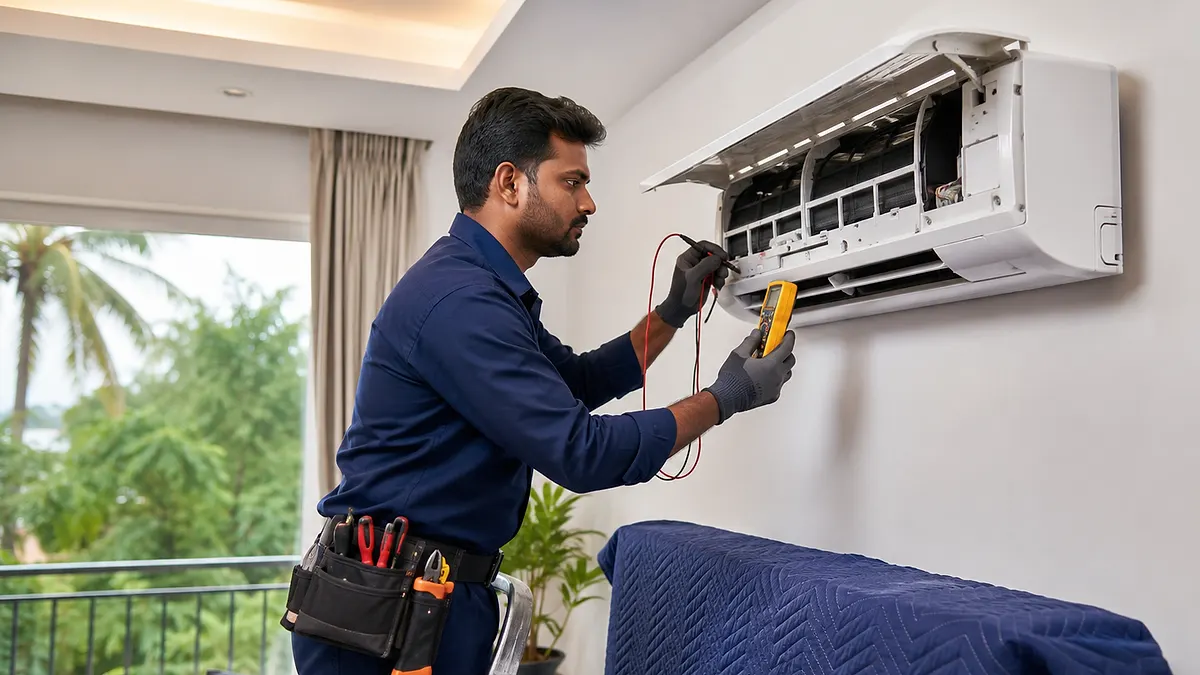
Why is the AC louver not moving?
A swing flap may stop because swing mode is disabled, the remote command is not received, dirt or a foreign object blocks movement, the flap is misaligned, gears are damaged, the small swing motor has failed or the control board is not sending a command. Do not force the flap by hand. Confirm settings, remove only visible loose obstruction with power off and arrange diagnosis if it remains stuck or clicks.
Protect the light plastic gears and linkage
A fixed louver may not stop cooling, but it can cause uneven air distribution and discomfort. Repeated clicking or partial travel can worsen gear or linkage damage.
Cuddalore humidity can make dust stick around louvers, while past cleaning may leave the flap misaligned. Compare remote and panel commands, inspect for physical obstruction with the unit isolated and use the model's reset procedure. Motor or PCB tests require controlled access.
Cuddalore has humid coastal exposure, seasonal heavy rain and salt-laden air. Drainage, insulation, outdoor corrosion and water entry deserve attention, but diagnosis must still follow observed evidence.
What to check before approving work
Start with safe, observable conditions and move to model-specific technical tests only when the evidence requires them.
Swing command
Verify the correct swing button, mode and remote display; replace remote batteries if other commands are also weak.
Visible alignment
With power off, look for a detached end, displaced flap or debris without forcing movement.
Sound pattern
Clicking, repeated attempts or one-direction travel can help locate gear, linkage or control trouble.
Professional checks for AC Swing Flap Diagnosis
Remote and receiver
Confirm that the indoor unit receives commands and that swing is permitted in the selected mode.
Flap and gears
Inspect alignment, pivots, linkages and gear teeth for binding or damage.
Motor and wiring
Test the correct swing motor, connector and command path using model data.
Air-distribution test
Verify full safe travel, remembered position and room airflow after repair.
Swing-flap patterns and the next inspection
One symptom can have several causes. Use the pattern, timing and accompanying signs to narrow the next test instead of replacing parts from a guess.
The table is a decision aid, not a substitute for model-specific procedures, safe instruments or manufacturer service information.
| Observation | Possible area | Next check |
|---|---|---|
| No movement or sound | Command, wiring or motor | Check receiver and control path |
| Clicks at one end | Gear or alignment | Stop forcing; inspect linkage |
| Moves only one direction | Motor, gear or feedback | Model-specific mechanism test |
| Flap droops when off | Pivot or clip damage | Inspect support and replace correct part |
Switch the system off when there is burning smell, smoke, repeated breaker tripping, water near wiring or unsafe access. Do not bypass a protection device.
How should the result be verified?
The final test should reproduce the original operating condition as closely as practical and show whether the reported problem is resolved.
Record the work completed, relevant readings, parts used and any remaining limitation so a future visit starts with evidence rather than assumptions.
- Swing responds to remote and panel commands.
- Flap travels without clicking or binding.
- The louver stops within its designed range.
- Airflow reaches the intended room zone.
- The flap closes or parks correctly when required.
From first observation to verified handover
- 1
Confirm the setting
Test swing and fixed-direction commands with fresh remote batteries.
- 2
Power down
Isolate before inspecting flap alignment or visible obstruction.
- 3
Inspect mechanism
Check pivots, linkage, gears, motor connector and physical damage.
- 4
Test control
Verify motor command and correct replacement identity if required.
- 5
Calibrate and verify
Run full travel and confirm useful room airflow.
Share useful details before the visit
Send the model, AC type, location, symptom timing, settings, error code and a short video where useful. Mention recent cleaning, shifting, electrical work, refrigerant work or power events.
Ask for an itemised scope that separates inspection, cleaning, labour, parts, refrigerant and follow-up tests. Keep the service report for warranty and repeat-fault history.
Ask what is included, what is excluded, which findings support additional work and how the final result will be tested.
Common mistakes to avoid
- Forcing the flap while its motor is engaged.
- Using glue on moving gears without correct repair.
- Replacing the motor before checking alignment and command.
- Approving work without asking how the final result will be tested and recorded.
Frequently asked questions
Can I move the AC swing flap by hand?
Avoid forcing it because small gears and pivots can break. Use the remote and model instructions; inspect only with safe power isolation.
Will the AC cool if the swing flap is stuck?
It may still cool, but air distribution can be uneven and direct drafts can reduce comfort. A closed or badly positioned flap may also restrict airflow.
Why does the flap make a clicking sound?
A blocked, misaligned or damaged gear or linkage may be repeatedly slipping. Stop repeated operation and arrange inspection.
Can remote batteries cause swing failure?
Yes if commands are not being transmitted, although other remote functions may also fail. Test fresh batteries and the indoor receiver response.
Does louver repair require replacing the PCB?
Not automatically. The flap, gears, motor, connector, receiver and command output should be tested before a board decision.
Talk to Turbo Cooling Solutions
Share your location, AC type and requirement for a clear service response.