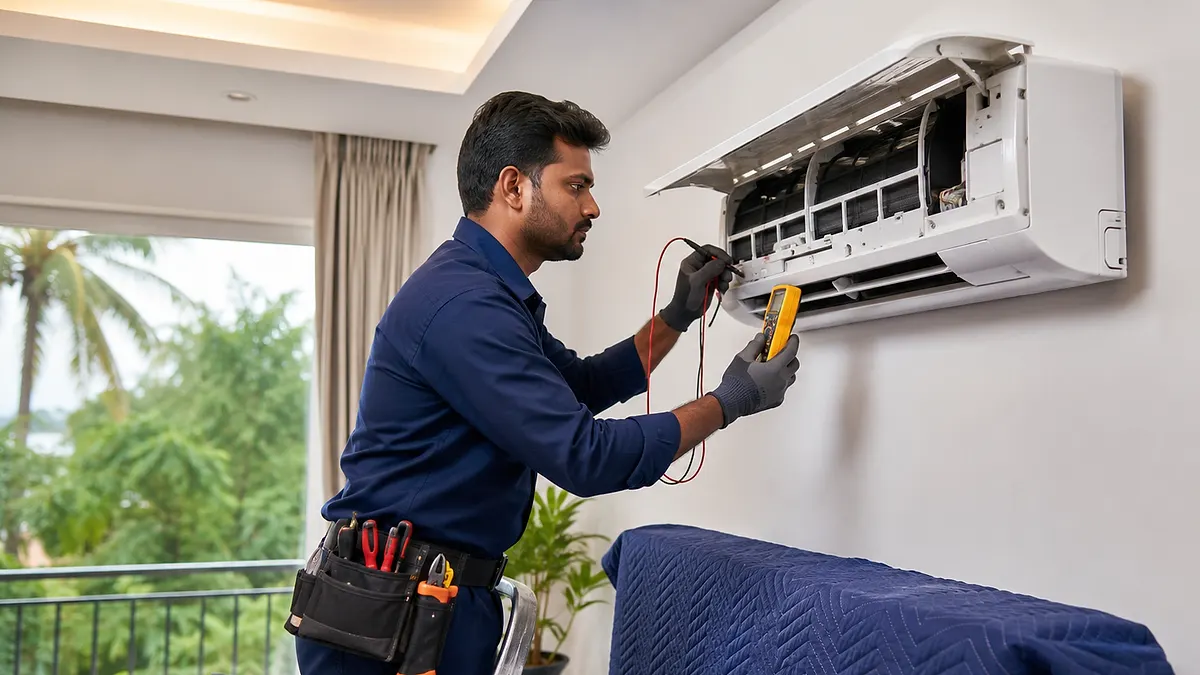
Why does an AC keep switching on and off?
AC short cycling means the compressor or complete system starts and stops more frequently than expected without maintaining stable comfort. Common causes include incorrect settings, airflow restriction, coil icing, sensor position, voltage instability, control faults, unsuitable capacity and refrigerant-circuit problems; diagnosis should proceed from safe simple checks to measured technical tests.
Observe the complete cycle before replacing parts
Normal inverter modulation is not the same as short cycling. An inverter system may reduce compressor speed as the room approaches set temperature. A fault is more likely when starts and stops are abrupt, comfort is unstable, error codes appear or protection repeatedly activates.
Record how long the unit runs, room temperature, set point, fan mode, error indication and whether the outdoor unit also stops. Switch the AC off and request professional help if a breaker trips, wiring smells hot, water reaches electrical parts or the compressor repeatedly attempts to start with abnormal sound.
Pondicherry's hot, humid conditions can create long cooling demand, while salt exposure and moisture may affect outdoor components and connectors. Climate can increase stress, but short cycling still requires evidence-based diagnosis rather than assuming gas shortage.
Three groups of short-cycling causes
Grouping the evidence prevents random part replacement and unnecessary refrigerant charging.
Settings and airflow
Check mode, set temperature, timer, filter condition, intake obstruction, louvers and signs of an iced coil.
Sensors and electrical supply
Inspect sensor placement, connectors, supply voltage behaviour, isolator, capacitor where applicable and control-board fault evidence.
System design and refrigerant circuit
Review capacity, installation airflow, coil condition, fan performance, pressure and temperature evidence before concluding that the refrigerant circuit is responsible.
What professional short-cycling diagnosis should include
Operating history
Confirm when the behaviour began, cycle length, weather, recent service, power events and error codes.
Air-path inspection
Check filters, coils, blower, outdoor airflow and icing before refrigerant conclusions.
Electrical and control tests
Measure relevant supply and component behaviour using model-compatible procedures.
Post-repair cycle test
Run the system long enough to confirm stable operation, comfort response and no repeat protection event.
What different short-cycling patterns may suggest
A very rapid start attempt with clicking or dimming lights can point toward electrical or compressor-start trouble. Longer cycles that stop before comfort is reached may involve sensors, icing, airflow or protective controls. A unit that satisfies the set point quickly may simply be oversized or serving a lightly loaded room.
These patterns narrow the inspection; they do not prove a failed part. Measurements and manufacturer error information are still needed.
| Observed pattern | Possible area | Safe response |
|---|---|---|
| Frequent stop with dirty filter or ice | Airflow or freezing | Switch off if iced and arrange inspection |
| Clicking and failed restart | Electrical or start circuit | Stop repeated attempts |
| Stops near set temperature | May be normal control | Observe comfort and inverter behaviour |
| Trips breaker or smells hot | Electrical safety fault | Isolate and seek trained service |
Do not bypass safety controls or repeatedly reset a tripping breaker to keep the AC running.
Capacity and airflow can create similar symptoms
An oversized fixed-speed AC may cool the sensor area quickly and stop before the room is evenly comfortable. Poor airflow can also make coil temperatures abnormal and cause protective cycling.
Review room heat load, indoor position, return-air path, fan condition and equipment capacity before replacing major components. Correct sizing and optimized airflow are central to stable performance.
- Confirm room usage and heat sources.
- Keep the return path open.
- Check whether cycling began after relocation or installation.
- Compare behaviour in normal cooling mode without timers.
A safe path from symptom to verified repair
- 1
Record the cycle
Note run time, stop time, settings, room condition and error indications.
- 2
Complete safe user checks
Review mode, filter and visible obstruction without opening electrical sections.
- 3
Inspect and measure
A trained technician checks airflow, coils, sensors, supply and system evidence.
- 4
Correct the confirmed cause
Clean, adjust, repair or replace only after the cause is supported.
- 5
Verify stable cycling
Operate the AC under load and confirm the original behaviour does not return.
What to tell the AC technician
Share a short video showing the display and sound, the approximate run and stop intervals, the set temperature, whether the outdoor unit stops and any breaker, smell, water or error-code warning.
Mention recent installation, shifting, cleaning, refrigerant charging or electrical work because timing can help isolate the cause.
Ask what is included, what is excluded, which findings support additional work and how the final result will be tested.
Common mistakes to avoid
- Calling normal inverter speed reduction a compressor fault.
- Adding refrigerant before checking airflow and leak evidence.
- Repeatedly resetting a breaker or protection code.
- Approving work without asking how the final result will be tested and recorded.
Frequently asked questions
What is AC short cycling?
Short cycling is repeated starting and stopping that occurs more frequently than expected and prevents stable comfort. It should be distinguished from normal inverter modulation and ordinary thermostat control.
Can a dirty filter make an AC switch off repeatedly?
A heavily restricted filter can reduce airflow and contribute to abnormal coil temperatures or protective operation. The coil, blower and complete air path should also be checked.
Does short cycling mean the AC needs gas filling?
No. Refrigerant-circuit trouble is only one possibility. Settings, airflow, icing, sensors, voltage, electrical components, controls and sizing should be assessed logically.
Should I keep restarting a short-cycling AC?
No if the breaker trips, wiring smells hot, water is near electrical parts, abnormal compressor sound occurs or a protection code repeatedly returns. Switch it off and arrange diagnosis.
Can an oversized AC cause frequent cycling?
An oversized fixed-speed unit may satisfy the sensor quickly and stop before the room reaches even comfort. A proper heat-load and installation review can identify this possibility.
Talk to Turbo Cooling Solutions
Share your location, AC type and requirement for a clear service response.