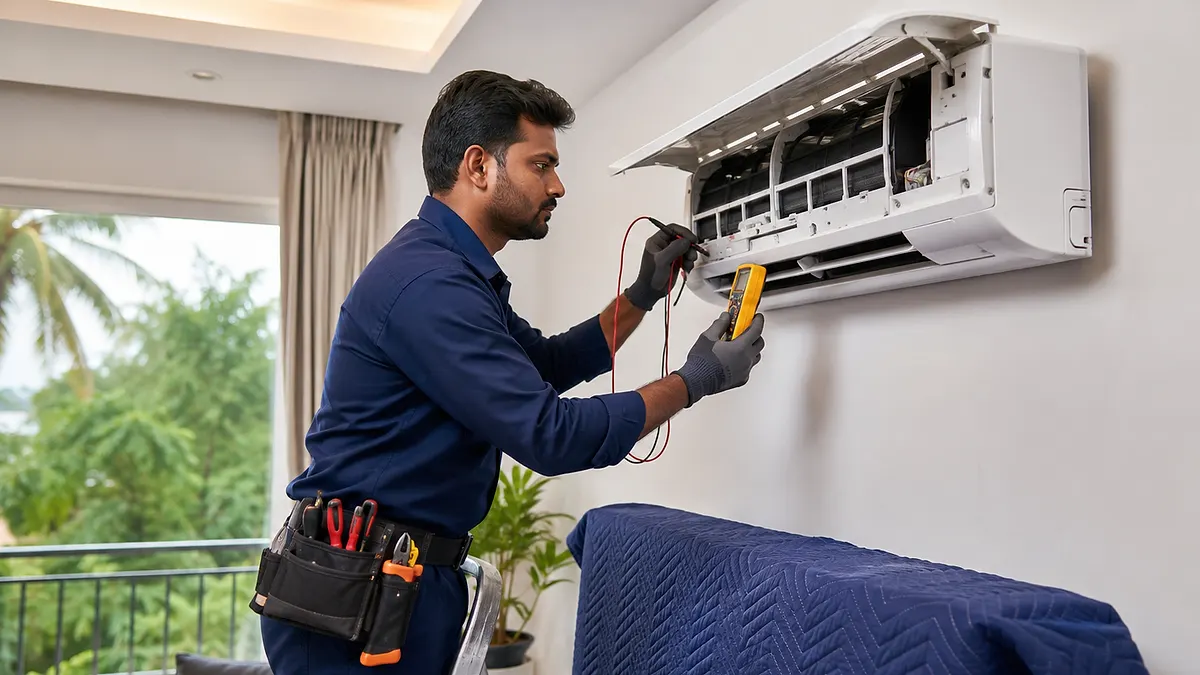
Why is the AC outdoor unit not starting?
An outdoor unit may remain off because the room is already satisfied, a restart delay is active, the mode or timer is wrong, power is unavailable, a communication or sensor fault exists, the fan or start circuit has failed, or compressor protection has operated. Do not open the cabinet or touch capacitors. Confirm settings and breakers once, preserve any error code and request qualified diagnosis if it does not start.
Rule out normal delay before treating the stop as failure
The indoor display and blower use different circuits from the outdoor compressor and fan, so the room unit can appear normal while cooling equipment is stopped. Inverter models may also vary speed or pause according to controls.
Set Cool mode and a temperature below the room condition, remove timers and wait through the manufacturer's protective delay. From a safe position, check for an error display, outdoor sound or fan movement. Pondicherry salt exposure can affect terminals and boards, but the cabinet must remain closed for trained inspection.
Pondicherry combines hot-humid weather with coastal salt exposure, dense urban rooms and long summer operating hours. Inspect the actual installation and operating conditions instead of treating climate as proof of one fault.
Safe checks before calling for outdoor-unit repair
Start with safe, observable conditions and move to model-specific technical tests only when the evidence requires them.
Demand and delay
Confirm Cool mode, set point and any restart or anti-short-cycle delay.
Supply status
Check the labelled AC breaker or isolator once; stop if it trips again.
Error and sound
Record display codes, clicking, humming or failed fan movement without approaching rotating or live parts.
Professional checks for AC Outdoor Unit Diagnosis
Indoor-to-outdoor command
Verify demand, communication and control outputs using model diagnostics.
Electrical supply
Inspect isolator, cabling, terminals and voltage safely under the required operating condition.
Fan and compressor
Test motor, start components where used, inverter module and compressor according to the model.
Heat-rejection condition
Check condenser cleanliness, clearances, corrosion and signs of overheating or refrigerant trouble.
Outdoor-unit clues and responsible next actions
One symptom can have several causes. Use the pattern, timing and accompanying signs to narrow the next test instead of replacing parts from a guess.
The table is a decision aid, not a substitute for model-specific procedures, safe instruments or manufacturer service information.
| Observation | Possible area | Next check |
|---|---|---|
| No sound after valid demand | Supply, communication or control | Trace command and safe power path |
| Humming without start | Motor, start circuit or compressor | Stop repeated attempts; test components |
| Fan runs, compressor does not | Protection, drive or compressor | Use error and electrical evidence |
| Starts then stops hot | Airflow, fan or thermal protection | Inspect condenser and operating load |
Switch the system off when there is burning smell, smoke, repeated breaker tripping, water near wiring or unsafe access. Do not bypass a protection device.
How should the result be verified?
The final test should reproduce the original operating condition as closely as practical and show whether the reported problem is resolved.
Record the work completed, relevant readings, parts used and any remaining limitation so a future visit starts with evidence rather than assumptions.
- Outdoor fan and compressor respond correctly to demand.
- No breaker or protection event repeats.
- Condenser airflow is unobstructed.
- Indoor cooling and drainage are restored.
- The service report states the confirmed fault and final test.
From first observation to verified handover
- 1
Confirm cooling demand
Review mode, set point, delay, timer and indoor indications.
- 2
Preserve evidence
Record errors, sound, smell and whether the fan or compressor attempts to start.
- 3
Isolate and diagnose
A trained technician checks communication, supply, controls, fan and compressor.
- 4
Correct contributing conditions
Address airflow, corrosion, loose connections or refrigerant issues as proven.
- 5
Run-test
Verify stable outdoor operation and room cooling under load.
Share useful details before the visit
Send the model, AC type, location, symptom timing, settings, error code and a short video where useful. Mention recent cleaning, shifting, electrical work, refrigerant work or power events.
Ask for an itemised scope that separates inspection, cleaning, labour, parts, refrigerant and follow-up tests. Keep the service report for warranty and repeat-fault history.
Ask what is included, what is excluded, which findings support additional work and how the final result will be tested.
Common mistakes to avoid
- Opening the outdoor cabinet without electrical training.
- Pushing the fan blade or bypassing a control.
- Repeatedly resetting a tripping breaker.
- Approving work without asking how the final result will be tested and recorded.
Frequently asked questions
Can the indoor AC run when the outdoor unit is off?
Yes. The indoor blower and display can operate while the outdoor section is delayed, not commanded, unpowered or in fault.
How long is a normal outdoor-unit restart delay?
It varies by model. Many units protect the compressor with a short delay; use the product manual rather than repeatedly switching power.
Does a stopped outdoor unit mean the compressor failed?
No. Demand, supply, communication, sensors, fan, controls and protection should be tested before condemning the compressor.
Can coastal corrosion stop an outdoor unit?
Corrosion can affect terminals, boards, coils and structural parts, but its role must be confirmed by inspection and testing.
When is the outdoor-unit problem urgent?
Switch off and seek prompt help for burning smell, smoke, repeated tripping, severe vibration, exposed wiring or failed mounting.
Talk to Turbo Cooling Solutions
Share your location, AC type and requirement for a clear service response.