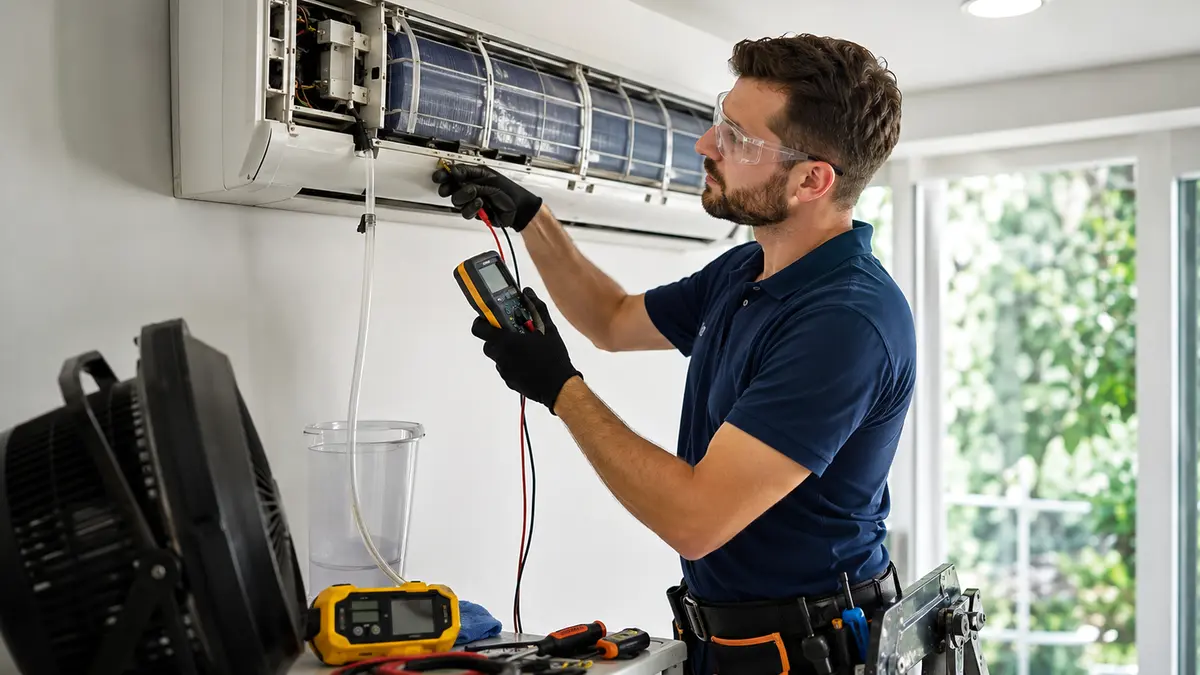
Why has the AC indoor blower stopped?
If the indoor fan does not spin, turn the AC off when there is humming, burning smell, ice, water near wiring or a repeated error. Confirm mode, fan setting and whether a normal delay applies, but do not reach through the louvers. A technician should inspect obstruction, blower condition, motor bearings, wiring, sensors, control output and the correct motor or capacitor arrangement for the model.
Do not force the blower through the outlet louvers
No indoor airflow can quickly affect coil temperature and drainage, so continued cooling attempts may create ice or water leakage. The problem may be mechanical, electrical or control-related.
Switch off power before any qualified inspection. Roadside dust common in parts of Villupuram can load the blower and filter, but a stalled fan may also involve bearings, a motor, connector, PCB drive or sensor. Cleaning alone should not be promised until free movement and electrical evidence are checked.
Villupuram homes and businesses can face strong seasonal heat, roadside dust and variable operating schedules. Filter loading, outdoor airflow and electrical conditions should be checked with the reported symptom.
What to check before approving work
Start with safe, observable conditions and move to model-specific technical tests only when the evidence requires them.
Mode and delay
Confirm fan or cooling mode and allow for a model-specific start delay.
Visible ice or blockage
Stop cooling if ice is visible or airflow paths are heavily blocked.
Sound and error
Record humming, clicking, error codes or intermittent fan attempts for the technician.
Professional checks for AC Indoor Fan Diagnosis
Blower inspection
Check contamination, obstruction, balance, damage and bearing movement with power isolated.
Motor identification
Confirm AC or DC motor type, ratings, feedback and model-specific test method.
Control path
Inspect wiring, connectors, sensors and board command before replacing the motor.
Cooling and drain check
After repair, verify airflow, coil condition, condensate drainage and normal sound.
Indoor-fan symptoms and likely test areas
One symptom can have several causes. Use the pattern, timing and accompanying signs to narrow the next test instead of replacing parts from a guess.
The table is a decision aid, not a substitute for model-specific procedures, safe instruments or manufacturer service information.
| Observation | Possible area | Next check |
|---|---|---|
| Fan silent, display normal | Command, wiring or motor | Check board output and motor circuit |
| Hums but does not turn | Mechanical or start fault | Isolate; inspect blower and motor |
| Starts and stops | Feedback, sensor or thermal issue | Monitor command and motor condition |
| Fan runs slowly with dirt | Blower restriction or drive | Clean safely and retest electrically |
Switch the system off when there is burning smell, smoke, repeated breaker tripping, water near wiring or unsafe access. Do not bypass a protection device.
How should the result be verified?
The final test should reproduce the original operating condition as closely as practical and show whether the reported problem is resolved.
Record the work completed, relevant readings, parts used and any remaining limitation so a future visit starts with evidence rather than assumptions.
- Blower starts at each commanded speed.
- Airflow is even and unobstructed.
- No rubbing, humming or abnormal vibration remains.
- The coil does not ice during the test.
- Condensate drains without indoor leakage.
From first observation to verified handover
- 1
Stop unsafe operation
Turn off the unit for smell, heat, ice, water or repeated error.
- 2
Confirm the command
Check mode, speed setting, delay and display evidence.
- 3
Inspect mechanically
With isolation, assess blower freedom, contamination and damage.
- 4
Test electrically
Use model-specific checks for motor, feedback, wiring and PCB output.
- 5
Verify all speeds
Run-test airflow, noise, coil and drainage after correction.
Share useful details before the visit
Send the model, AC type, location, symptom timing, settings, error code and a short video where useful. Mention recent cleaning, shifting, electrical work, refrigerant work or power events.
Ask for an itemised scope that separates inspection, cleaning, labour, parts, refrigerant and follow-up tests. Keep the service report for warranty and repeat-fault history.
Ask what is included, what is excluded, which findings support additional work and how the final result will be tested.
Common mistakes to avoid
- Putting fingers or tools through moving louvers.
- Replacing the motor before checking board command and wiring.
- Continuing cooling when the coil is icing.
- Approving work without asking how the final result will be tested and recorded.
Frequently asked questions
Can a dirty filter stop the indoor AC fan?
A filter mainly restricts airflow; heavy dirt elsewhere may load the blower. A completely stopped fan still needs mechanical, motor and control checks.
Can I spin the blower by hand?
Do not reach through the outlet. Inspection should occur only after safe electrical isolation by a person who can access and reassemble the unit correctly.
Does an indoor fan need a capacitor?
Some motors use a capacitor and others use electronic drive or feedback. The exact model and wiring diagram determine the test.
Why does water leak when the fan stops?
Low airflow can contribute to icing, and melting ice or poor drainage can overflow. Both airflow and drainage require inspection.
Should the full blower be cleaned after motor repair?
Clean it when contamination is confirmed and the method is safe. Balance, alignment and final airflow should be checked after reassembly.
Talk to Turbo Cooling Solutions
Share your location, AC type and requirement for a clear service response.