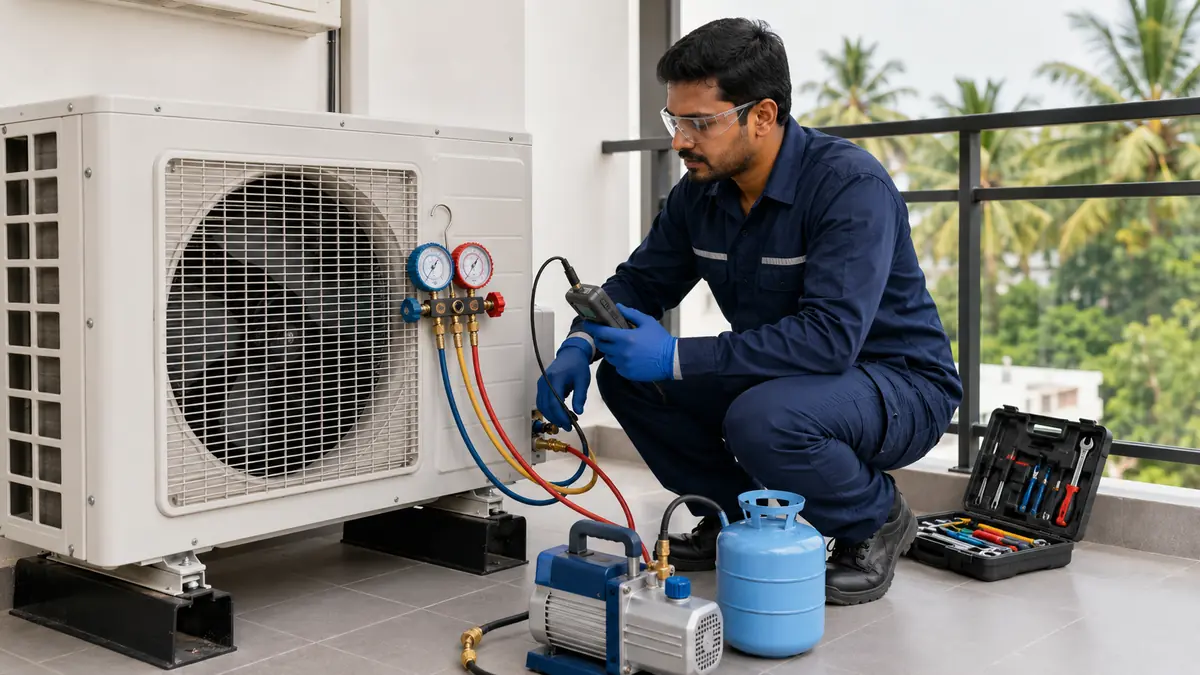
What should you expect?
AC gas refilling in Pondicherry should never begin from guesswork. A responsible service checks airflow and heat rejection, confirms refrigerant-related evidence, looks for leaks, repairs the cause where practical, follows equipment-specific vacuum and charging procedures, and verifies performance.
Does every weak-cooling AC need gas refilling?
Refrigerant does not get consumed like fuel in a correctly sealed AC. If charge is low, leakage or earlier incorrect service may be involved. Pondicherry’s coastal exposure can also affect accessible joints and outdoor components, but evidence is needed before conclusions.
No. Dirty filters, blocked coils, poor outdoor ventilation, fan problems, incorrect settings, sensor faults and high room heat load can also reduce cooling. Refrigerant work should follow airflow and operating checks, not replace them.
Pondicherry’s coastal humidity, salt-laden air, monsoon moisture and long cooling seasons can increase filter loading, condenser fouling, corrosion risk, insulation wear and drain problems. Service decisions should follow the AC type, actual condition, daily use and manufacturer guidance.
Evidence to check before adding refrigerant
One sign alone is not enough. The technician should combine equipment history, condition and suitable measurements.
Airflow is first
Filters, blower, coil and outdoor ventilation must be checked because restrictions can mimic low-charge symptoms.
Leak indicators
Oil traces, accessible joint condition, electronic detection or pressure testing may support a leak diagnosis.
Correct refrigerant identity
Use the equipment label and documentation; refrigerant types must not be guessed, mixed or substituted casually.
Charge and result verification
The approved method should follow equipment guidance and be followed by stable operating checks.
Responsible AC gas-refilling scope
Symptom and airflow diagnosis
Confirm the complaint and separate contamination, fans, controls and heat-rejection problems from refrigerant symptoms.
Leak assessment
Inspect accessible piping, joints and components using appropriate detection methods before proposing recharge.
Repair, vacuum and charge
Correct confirmed leakage where appropriate, use the specified refrigerant and follow model-compatible procedures.
Final performance checks
Verify stable cooling, airflow, temperatures, controls, current behavior and absence of immediate repeat leakage.
From enquiry to tested handover
- 1
Share model and symptom
Provide the equipment model, cooling behavior, icing, previous gas work and repair history.
- 2
Check airflow and operating evidence
Rule out common non-refrigerant causes before connecting service instruments.
- 3
Assess leakage and approve repair
Explain detected evidence, proposed correction, refrigerant type, quantity method and exclusions.
- 4
Complete controlled refrigerant work
Use trained handling, suitable tools, model-compatible evacuation and charging procedures, and avoid venting.
- 5
Run and verify
Check stable operation, cooling response and relevant measurements, then record the work completed.
What affects AC gas-refilling cost?
Cost depends on AC type and capacity, refrigerant type, the amount actually required, leak-detection time, repair location, access, replacement components and the charging procedure. A refill-only quote may not include finding or repairing the cause of loss.
Ask the quotation to separate diagnosis, leak repair, parts, evacuation, refrigerant and final testing. Repeated top-ups without a cause assessment can cost more and may release refrigerant unnecessarily.
Ask what is included, what is excluded, which findings support additional work and how the final result will be tested.
Common mistakes to avoid
- Assuming every cooling complaint means low gas.
- Repeatedly topping up refrigerant without finding or explaining the source of loss.
- Mixing or substituting refrigerants, venting them, or skipping final operating verification.
- Approving work without asking which final measurements, drainage checks and operating tests will confirm the result.
Local AC support across Pondicherry
Service availability depends on the exact address, AC type, access, required scope and current schedule. The locality examples below help users describe the site clearly; they do not replace booking confirmation.
Central Pondicherry
Enquiries from White Town, Heritage Town, Orleanpet, Nellithope and nearby central areas can be checked against technician availability and site access.
North and west neighborhoods
Lawspet, Muthialpet, Kalapet, Oulgaret and surrounding locations may have different building access, outdoor-unit exposure and operating conditions.
South and suburban areas
Mudaliarpet, Reddiarpalayam, Ariyankuppam and nearby areas can be reviewed when the address, AC type and requested service are shared.
Frequently asked questions
How do I know whether my AC gas is low?
Poor cooling or icing can occur with low charge, but also with dirty airflow paths, fan problems, sensors or outdoor blockage. A technician should inspect and measure before confirming refrigerant loss.
Does AC gas finish over time?
Refrigerant circulates in a sealed system and is not consumed like fuel. If charge is low, leakage or incorrect earlier work should be considered.
Should an AC leak be repaired before gas filling?
Where a leak is confirmed and repair is practical, the cause should normally be corrected before evacuation and charging. The exact method depends on the equipment and leak location.
Can different AC gases be mixed?
No casual mixing or substitution should occur. The refrigerant must match the equipment label and manufacturer documentation, and handling should be completed by trained personnel.
Can I request AC gas refilling in Pondicherry?
Refrigerant-service enquiries can be reviewed for Pondicherry. Share the model, symptom, previous gas history and address so diagnostic scope and availability can be discussed.
Talk to Turbo Cooling Solutions
Share your Pondicherry address, AC type, model, symptom and preferred timing so the requirement can be reviewed before work is confirmed.