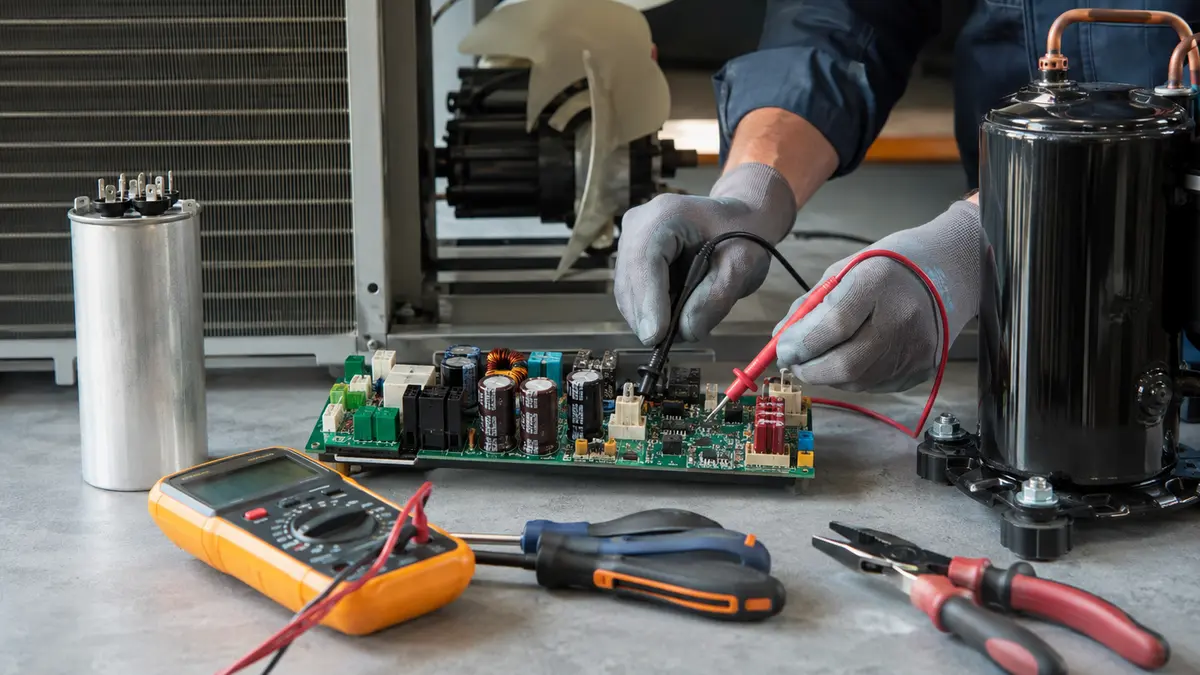
What should you do when the outdoor fan stops?
A stopped condenser fan can cause poor heat rejection, high operating stress and protective shutdown. Turn the AC off if the compressor runs while the fan is stopped, the unit overheats, hums, smells burnt or trips. Do not push the blade. A technician should inspect obstruction, bearings, motor windings or electronic motor feedback, wiring, capacitors where fitted, control output and condenser condition.
Stop compressor operation until the fan system is assessed
The fan may pause normally when the compressor is not commanded, but it should operate as designed during heat rejection. Motor type and control logic vary, especially between fixed-speed and inverter units.
Cuddalore salt exposure can corrode fan guards, motor brackets and connectors, while storm debris can obstruct blades. Safe diagnosis separates mechanical binding from motor, capacitor, board, sensor or command faults and checks whether overheating has affected other parts.
Cuddalore has humid coastal exposure, seasonal heavy rain and salt-laden air. Drainage, insulation, outdoor corrosion and water entry deserve attention, but diagnosis must still follow observed evidence.
What to check before approving work
Start with safe, observable conditions and move to model-specific technical tests only when the evidence requires them.
Compressor status
Observe from a distance whether compressor sound or vibration continues while the fan remains still.
Obstruction and damage
With power off, a technician checks debris, guard damage and blade condition.
Error or protection
Record codes, run time to shutdown, humming and any burning smell or trip.
Professional checks for AC Condenser Fan Diagnosis
Mechanical condition
Inspect blade, guard, shaft, bearings and corrosion after verified isolation.
Motor and drive
Identify motor type and test windings, feedback, capacitor or drive as applicable.
Control command
Check wiring, connectors, sensor inputs and PCB output before replacing parts.
Condenser and system test
Restore clear airflow and verify pressures, temperatures and stable operation.
Condenser-fan clues and likely test areas
One symptom can have several causes. Use the pattern, timing and accompanying signs to narrow the next test instead of replacing parts from a guess.
The table is a decision aid, not a substitute for model-specific procedures, safe instruments or manufacturer service information.
| Observation | Possible area | Next check |
|---|---|---|
| Blade blocked by debris | Mechanical obstruction | Isolate, clear and inspect damage |
| Motor hums, blade still | Motor, bearing or start component | Stop and test circuit |
| No motor command | Board, sensor or wiring | Trace model control logic |
| Fan starts then slows | Motor, drive or overheating | Measure under operating load |
Switch the system off when there is burning smell, smoke, repeated breaker tripping, water near wiring or unsafe access. Do not bypass a protection device.
How should the result be verified?
The final test should reproduce the original operating condition as closely as practical and show whether the reported problem is resolved.
Record the work completed, relevant readings, parts used and any remaining limitation so a future visit starts with evidence rather than assumptions.
- Fan starts and modulates as the model requires.
- Blade runs without contact or imbalance.
- Condenser airflow is open.
- No thermal protection or abnormal current returns.
- Cooling remains stable after a full test.
From first observation to verified handover
- 1
Stop the system
Prevent extended compressor operation without intended condenser airflow.
- 2
Isolate and inspect
Check obstruction, blade, guard, bearings and corrosion.
- 3
Test motor path
Measure motor, feedback, wiring, controls and start component where fitted.
- 4
Correct root cause
Repair damage and restore condenser cleanliness and clearance.
- 5
Verify under heat load
Confirm fan and compressor operate without protection.
Share useful details before the visit
Send the model, AC type, location, symptom timing, settings, error code and a short video where useful. Mention recent cleaning, shifting, electrical work, refrigerant work or power events.
Ask for an itemised scope that separates inspection, cleaning, labour, parts, refrigerant and follow-up tests. Keep the service report for warranty and repeat-fault history.
Ask what is included, what is excluded, which findings support additional work and how the final result will be tested.
Common mistakes to avoid
- Pushing the fan blade while power may be present.
- Running the compressor with no condenser airflow.
- Replacing a capacitor on a model that uses a different motor system.
- Approving work without asking how the final result will be tested and recorded.
Frequently asked questions
Can I run the AC if the condenser fan is stopped?
Do not continue if the compressor operates without the required fan because heat and pressure can rise and trigger damage or protection.
Can I push-start the outdoor fan?
No. The blade can start unexpectedly and live components may be exposed. Isolate and arrange qualified testing.
Does every condenser fan use a capacitor?
No. Motor and drive designs vary. Identify the exact model and circuit before testing or replacing components.
Can coastal corrosion stop the fan?
It can affect bearings, supports, connectors or controls, but inspection and electrical tests must confirm the cause.
What should be tested after fan repair?
Verify start and speed control, rotation, vibration, airflow, electrical load, condenser condition, protection and room cooling.
Talk to Turbo Cooling Solutions
Share your location, AC type and requirement for a clear service response.