What should you expect?
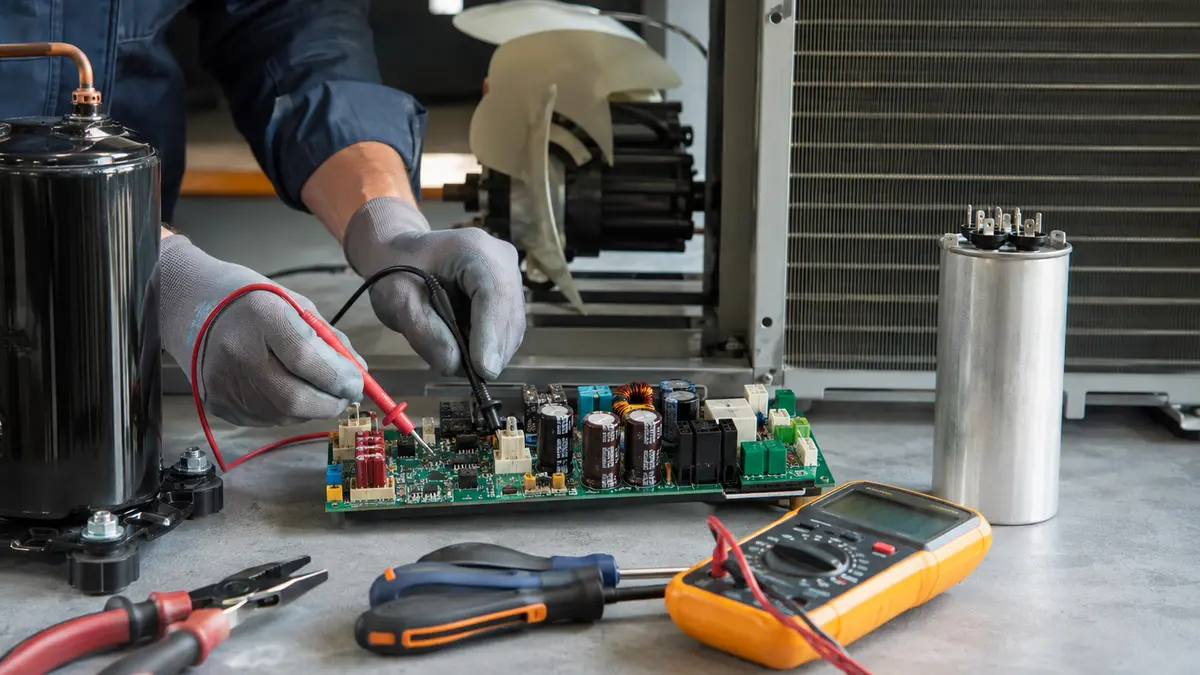
A capacitor should be replaced only after safe isolation, identification of the correct circuit and measured confirmation; the replacement rating and installation must match equipment requirements.
AC Capacitor Replacement: what Pondicherry users should know
A capacitor should be replaced only after safe isolation, identification of the correct circuit and measured confirmation; the replacement rating and installation must match equipment requirements. In Pondicherry and Puducherry, the decision should also account for coastal humidity, salt exposure, monsoon moisture and long operating hours.
Different faults can create similar symptoms. A safe diagnosis checks the simplest conditions first, uses measured evidence and explains why the proposed correction addresses the original complaint.
Pondicherry’s coastal humidity, salt-laden air, monsoon moisture and long daily cooling hours can accelerate corrosion, insulation wear, drainage trouble and condenser fouling. Use corrosion-aware placement, clear condensate drainage, protected pipe insulation and unrestricted outdoor airflow, then set service intervals from actual usage and condition.
What a careful diagnosis should check
Safe isolation
Disconnect and verify power, then discharge and handle the component using appropriate electrical procedures.
Measured diagnosis
Check the capacitor against its stated value and inspect related terminals, wiring and the motor or compressor load.
Exact specification
Use the required capacitance, voltage, temperature and physical type rather than a convenient substitute.
Operating verification
Confirm reliable starting, current behaviour, temperature, fan or compressor operation and secure mounting.
From symptom to verified repair
- 1
Describe the symptom
Share when the problem starts, operating mode, error code, recent service and any safety warning.
- 2
Inspect in a logical order
Check accessible airflow, drainage, electrical, control, mechanical and refrigerant evidence without guessing.
- 3
Explain the confirmed cause
Show the relevant finding and separate required repair from optional preventive work.
- 4
Approve a clear estimate
Review labour, part, material, refrigerant where applicable, exclusions and warranty before work.
- 5
Reproduce and verify
Operate the AC long enough to confirm the original symptom is corrected and safety checks pass.
Common mistakes to avoid
- Touching a charged capacitor.
- Changing capacitance to force a weak motor to start.
- Ignoring burnt terminals or the underlying load problem.
- Approving work without asking how the final result will be tested and recorded.
Frequently asked questions
What can cause weak or failed motor-start/run capacitor symptoms?
A capacitor should be replaced only after safe isolation, identification of the correct circuit and measured confirmation; the replacement rating and installation must match equipment requirements. A technician should confirm the cause with inspection and measured evidence before parts or refrigerant work is approved.
Can I continue using the AC when it has weak or failed motor-start/run capacitor symptoms?
Switch the AC off when there is a burning smell, breaker trip, water near wiring, heavy vibration, scraping sound or repeated protection fault. For other symptoms, arrange diagnosis before the fault worsens.
Will AC gas refilling solve weak or failed motor-start/run capacitor symptoms?
Not automatically. Airflow, drainage, electrical, sensor, control and outdoor-unit conditions can produce similar symptoms. Refrigerant work is appropriate only when system evidence supports it.
Can Turbo Cooling Solutions diagnose this AC problem in Pondicherry?
Turbo Cooling Solutions accepts AC diagnosis enquiries in Pondicherry. Share the AC type, model, age, symptom, error code and safety warning so the inspection scope can be confirmed.
Talk to Turbo Cooling Solutions
Share the Pondicherry location, AC type, exact model, symptom or installation requirement for a clear response.